TOR’s Revival: The Victory Lap Continues as Presidential Acclaim Reaches the Continental Stage
Tema Oil Refinery’s return to crude oil refining has moved beyond symbolism. With presidential endorsement on the continental stage and throughput steadily rising, TOR is re-emerging as a strategic lever against fuel price volatility, offering Ghana a rare domestic buffer in an increasingly fragile global energy market.
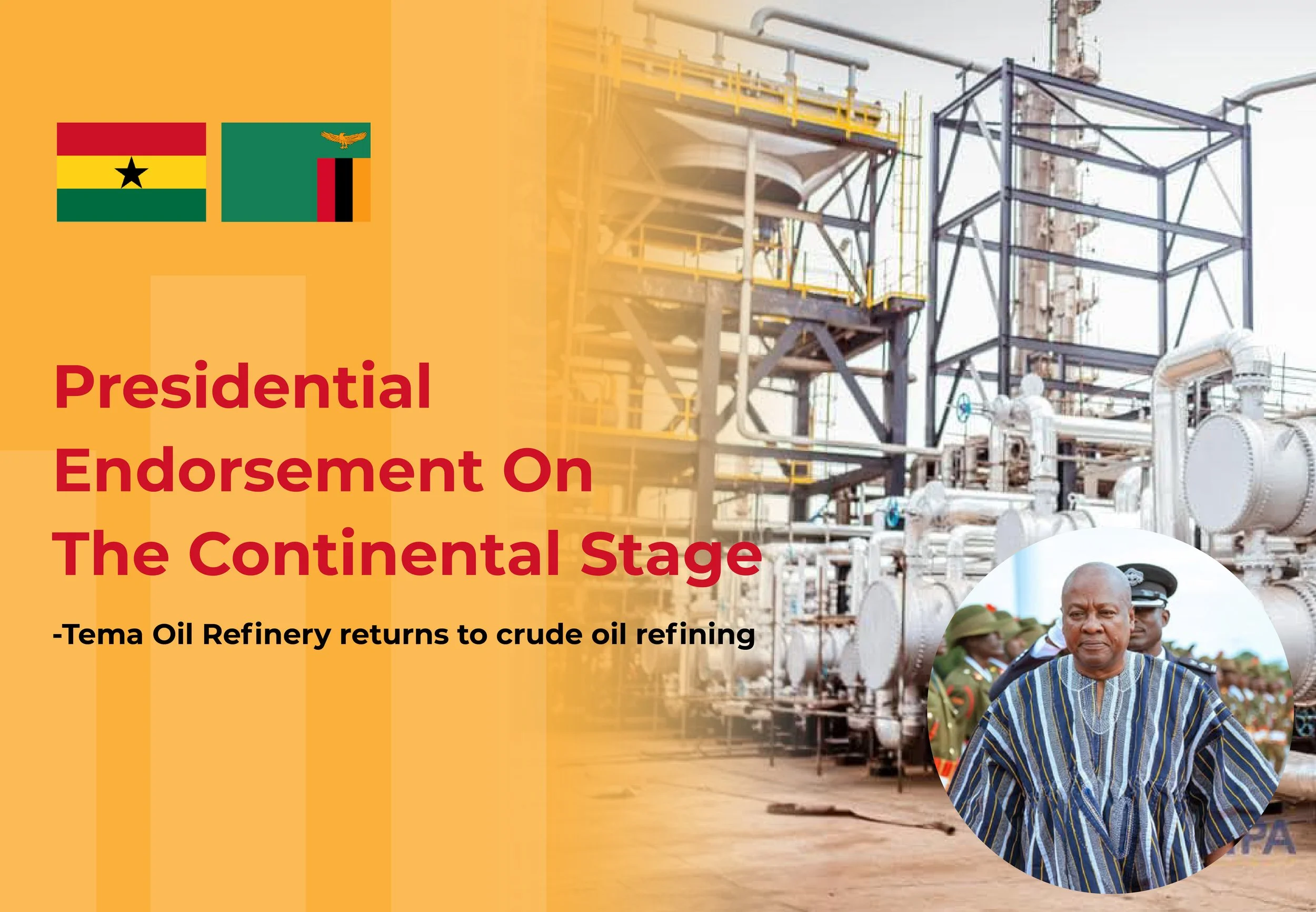
Lusaka, Zambia | February 5, 2026 - When President John Dramani Mahama chose an international platform to speak about Ghana’s downstream fortunes during his latest diplomatic engagement in Zambia, the message was neither ceremonial nor nostalgic. It was economic. Tema Oil Refinery’s return to crude oil refining, he argued, has begun to function as a structural counterweight to domestic fuel price volatility, easing inflationary pressures and offering the economy a rare stabilizing lever in an otherwise import-exposed energy system.
In framing TOR’s revival as a macroeconomic instrument rather than a legacy asset, the President elevated the refinery from a national recovery story to a strategic variable in Ghana’s inflation and cost-of-living equation. In a global environment marked by freight disruptions, refining bottlenecks, and price pass-through risks, domestic refining capacity, once written off, is being repositioned as a shield.
That framing matters. It suggests that TOR’s revival is no longer being defended on sentiment or sovereignty alone, but on its measurable contribution to price formation, supply security, and fiscal predictability.
From Restart to Throughput: The Operational Turn
Behind the policy narrative sits a refinery that is no longer idling. TOR is currently refining at approximately 28,000 barrels per day, with management signaling a near-term ramp-up toward 60,000 barrels per day, a level that would materially alter Ghana’s downstream supply mix.
This is not yet nameplate capacity, but it is a decisive break from dormancy. At these volumes, TOR meaningfully reduces the share of refined products exposed to international freight costs, spot market premiums, and currency transmission effects. Even partial substitution matters in a market where pump prices respond sharply to external shocks.
The implication is subtle but significant. TOR does not need to refine every barrel Ghana consumes to exert downward pressure. It needs only to be credible, consistent, and scalable.
State Alignment: From Political Endorsement to Institutional Synchrony
What distinguishes this phase of TOR’s revival from previous attempts is the visible alignment across the state architecture.
The Ministry of Energy and the Presidency have moved in concert, framing the refinery as a strategic national asset rather than a fiscal liability. The regulator, the National Petroleum Authority, has publicly described TOR’s return as a reclamation of Ghana’s refining backbone, signaling regulatory confidence in the refinery’s role within the downstream framework.
That endorsement is not trivial. Regulatory skepticism has historically shadowed TOR’s operations. The NPA’s posture now reflects a recalibration, one that treats domestic refining as complementary to market liberalization rather than antagonistic to it.
Industry Reception: Cautious Optimism, Conditional Support
Industry responses have been broadly supportive, though notably disciplined in tone.
The Institute of Energy Security has welcomed the refinery’s return to crude processing after years of shutdown, emphasizing its implications for supply resilience. The Chamber of Bulk Oil Distributors has characterized the revival as a strategic boost to the downstream, particularly in logistics and stockholding efficiency.
COPEC, while supportive, has struck a more conditional note, calling for sustained investment to ensure the refinery’s long-term viability. The subtext is clear. Revival without reinvestment risks repetition. Sustainability will depend on maintenance discipline, feedstock security, and governance insulation from political cycles.
Professional bodies have also weighed in. The Institute of Engineering and Technology, Ghana has commended TOR for prioritizing local engineering expertise, a signal that capacity rebuilding is extending beyond hardware to human capital.
System Integration: Energy Beyond the Fence Line
Perhaps the most underappreciated signal of TOR’s renewed seriousness lies outside the refinery gates.
GRIDCo’s engagement with TOR points to a growing appreciation that refining is not an isolated industrial activity but part of an integrated energy system. Power reliability, grid coordination, and industrial load planning are increasingly central to refinery economics. That alignment suggests a shift from episodic operation to system-embedded planning.
In practical terms, it reflects an understanding that TOR’s sustainability depends as much on upstream crude access and downstream offtake as it does on electricity stability and infrastructure coordination.
A Victory Lap, With Caveats
The President’s remarks abroad may sound like a victory lap, but the track ahead remains demanding. Scaling from 28,000 to 60,000 barrels per day will test procurement discipline, operational reliability, and financial resilience. Sustaining credibility will require transparency, predictable crude supply arrangements, and continued regulatory trust.
Still, the signal is unmistakable. TOR has re-entered the national conversation not as a burden to be explained away, but as an economic actor with measurable impact.
In an era where inflation control is increasingly shaped by energy dynamics beyond central bank reach, Ghana’s decision to restore refining capacity is beginning to look less like a throwback and more like a calculated hedge.
The refinery’s true test will not be whether it can restart, but whether it can endure. For now, the machinery is turning, the politics are aligned, and the economics are finally being allowed to speak.
