Defining, Developing, Delivering: Africa’s New Energy Frontier with the PHDC
The Petroleum Hub Development Corporation (PHDC) intensified its continental leadership drive through a blend of high-level international engagements, investor roadshows, strategic partnerships, and bold public advocacy. From Accra to Kuala Lumpur, from Takoradi to Cairo, the corporation demonstrated that Ghana’s $60 billion Petroleum Hub project is not only advancing steadily — it is emerging as the most consequential petro-industrial initiative on the continent.
Strategic Partnerships and Global Momentum
PHDC’s global outreach gained renewed traction this year, anchored by the corporation’s MoU with Surbana Jurong Group — the global infrastructure consultancy tasked with supporting the master-planning and implementation of the multi-faceted Petroleum Hub. This partnership strengthens the foundation laid by the GH₵300 million MoU with Mannschaft Engineering, PHDC’s local partner facilitating technical support, logistics, and landowner compensation across the 20,000-acre project site.
Momentum extended to Asia. From a high-level investor breakfast in Kuala Lumpur to PHDC’s showcase at TICAD-9, the corporation presented Ghana as Africa’s most strategically located and investment-ready destination for integrated petroleum and petrochemical infrastructure.
PHDC also deepened its diplomatic and governmental engagements.
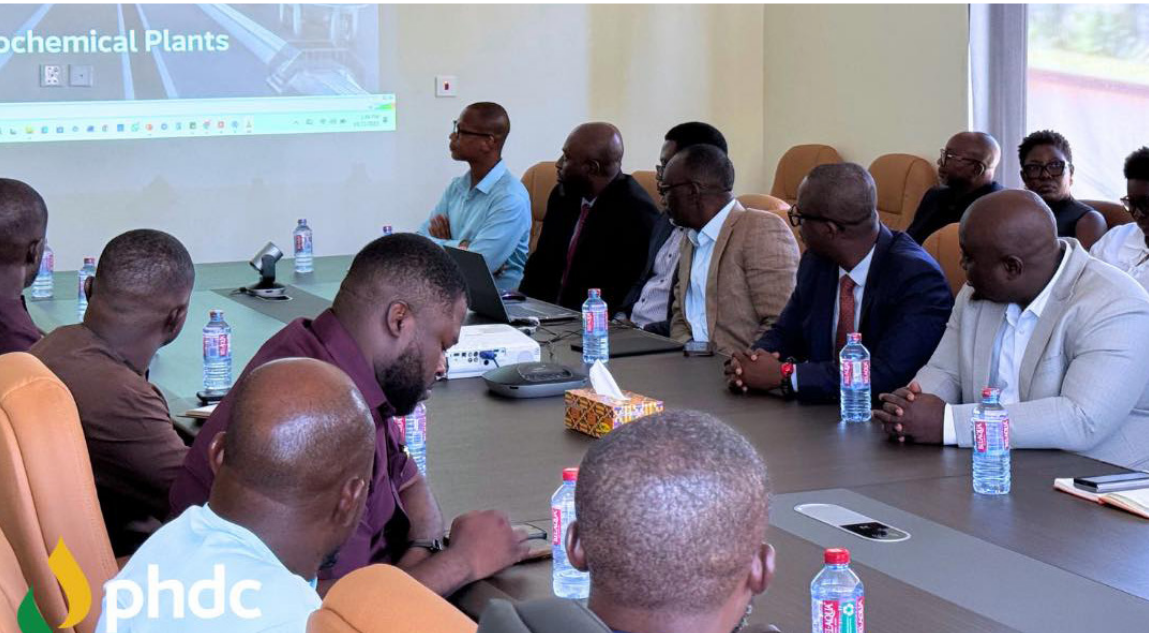
On September 30, Ghana’s Ambassador to South Korea, H.E. Kojo Choi, visited PHDC headquarters to discuss expanding South Korean participation in the Hub — from refineries and petrochemical plants to ancillary infrastructure such as roads, rail, and fertilizer plants. He pledged to champion the project across the Asian investment ecosystem. Earlier, the Legal Advisor to the President, Ms. Marietta Brew, had also visited, reinforcing the government’s commitment to the project’s progress.
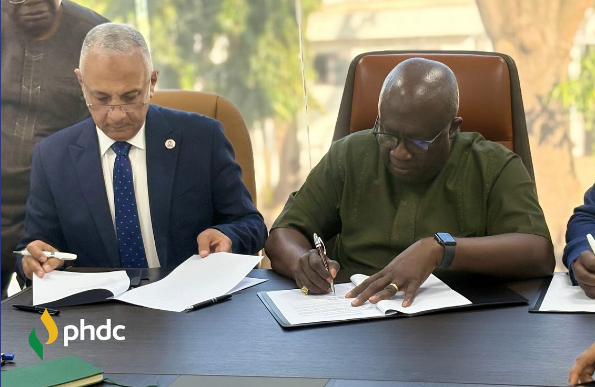
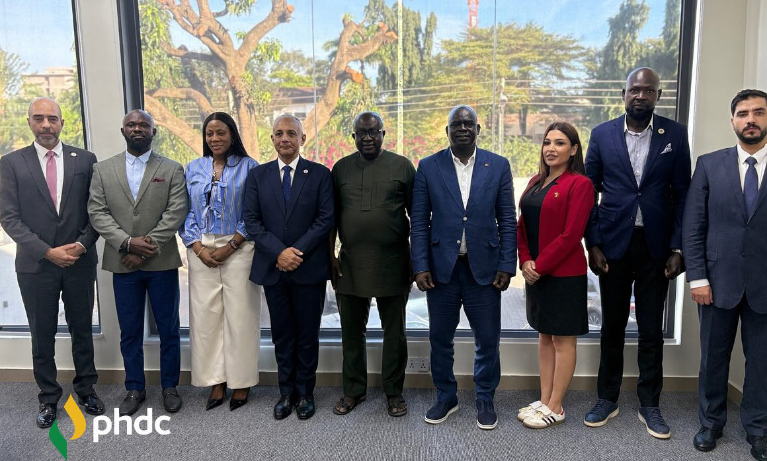
November featured prominently with the signing of a major MoU with Egypt’s Chemexa Petrochemical Trading and its Ghanaian partner, Afdat Group — paving the way for the development of storage tanks with a cumulative capacity of 7 million cubic metres. The agreement, the third secured under Acting CEO Dr. Toni Aubynn, deepens bilateral ties with Egypt while demonstrating the project’s widening international interest.
“This MoU is very important for us. The President and our Energy Minister are determined to develop this project — the first of its kind in Africa — and they will be very happy with this development,” Dr. Aubynn remarked at the signing ceremony.
Continental Leadership & Opportunity in Action
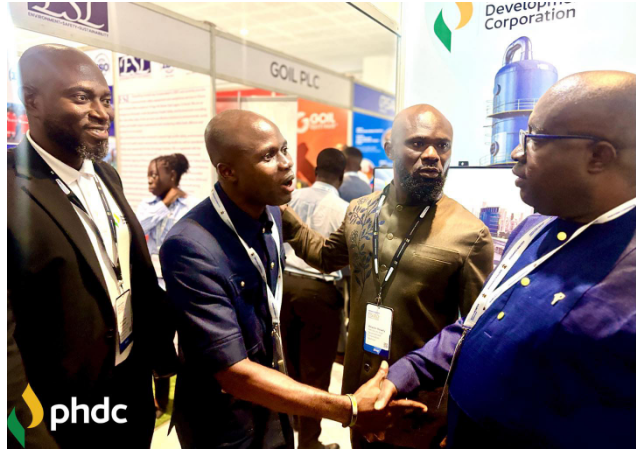
Ghana’s argument for the Petroleum Hub gained definitional clarity and momentum over a three-month arc of engagements that began on September 18, when Dr. Toni Aubynn, Acting CEO of the Petroleum Hub Development Corporation, took centre stage at Ghana Energy Day during Africa Oil Week (AOW) in Accra. Addressing industry leaders, investors and senior policymakers, he articulated what can be characterized as the country’s “Osagyefo disposition” — a forward-looking, nation-building posture that frames the Hub not merely as an infrastructure project but as a strategic platform for regional value creation. He described the Hub as a transformative initiative linking upstream petroleum production with downstream refining, petrochemicals, storage and logistics, stressing its potential to generate thousands of skilled jobs, attract long-term international capital, strengthen regional energy security, and position Ghana as the sub-region’s centre of industrial gravity. Drawing direct parallels with the bold development ethos of Osagyefo Dr. Kwame Nkrumah, he underscored that the Petroleum Hub is Ghana’s contemporary expression of a confident, self-defining national ambition — one that resonated strongly with international delegates and signalled Ghana’s readiness to anchor West Africa’s energy future.
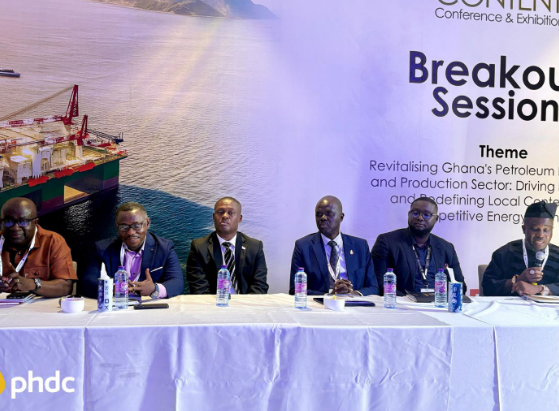
This posture crystallised further in early November during Dr. Aubynn’s extensive media engagements following his presentation at the 12th Local Content Conference and Exhibition in Takoradi. Responding to growing public debate around feedstock availability — heightened by Nigeria’s commissioning of the Dangote Refinery and Côte d’Ivoire’s plans for an additional refinery — he delivered an unequivocal assurance that the Hub will have uninterrupted access to raw materials. He drew a sharp distinction between Ghana’s integrated Petroleum Hub model and the standalone refineries being pursued elsewhere in the region, emphasising that Ghana’s project is the first of its kind in Africa: a complex system of refineries, petrochemical plants, storage facilities, jetties and a dedicated port. Its competitiveness, he explained, rests on structural advantages rather than domestic crude output.
Addressing concerns that declining local production could undermine the Hub, Dr. Aubynn was categorical. “You don’t need to produce oil to operate a world-class petroleum hub. Rotterdam produces no crude yet hosts one of the planet’s busiest and most profitable hubs. Singapore, which is the size of Accra, reclaimed land from the sea to build the world’s third-largest hub. They don’t produce a drop of oil. Malaysia tells a similar story; its Phase One alone employs over 80,000 people. The formula is simple: build world-class infrastructure, invite global crude, and let the market respond.” His remarks reinforced the investment case for Ghana and placed the Hub firmly within the logic of global energy logistics, not national production volumes.
The continental validation of Ghana’s strategic posture emerged in even sharper relief during the same conference, when a high-level Ugandan delegation engaged the industry. Philip Obita, General Manager for Upstream at the Uganda National Oil Company, urged Ghana to move decisively, arguing that the country sits before a historic opportunity. He observed that although Nigeria and Côte d’Ivoire were advancing efforts to position themselves as energy nodes, Ghana enjoyed a multifaceted competitive advantage that its neighbours could not match. Ghana’s “enduring peace and political stability,” its “pivotal geographic centrality,” and an “investor-friendly business ecosystem,” he said, created precisely the enabling environment global players look for. He pointed to Ghana’s existing oil and gas infrastructure as a springboard for constructing the next-generation facilities that would vault the country into sub-regional leadership and emphasised that the incentive packages outlined by the PHDC CEO were well-calibrated to stimulate investor interest.
Obita’s counsel was pointed and direct. “Nigeria’s problem is the lack of enabling environment. Ghana’s progressive policies and incentives will nurture a thriving petroleum hub. Nigeria also grapples with inadequate gas and power infrastructure. If Ghana capitalises on these gaps, it will secure an unassailable competitive advantage.” His remarks reframed the Hub not as an aspirational project but as a structurally favourable one, contingent mainly on the speed with which Ghana acts.
Taken together, the arc from AOW in September to the Local Content Conference in November illustrates a coherent national repositioning. Ghana’s “Osagyefo disposition” — the confidence to define its own industrial future — now converges with emerging themes in domestic policy, including the 24-hour economy agenda, as expressed by the CEO in recent media engagements. The Hub’s operational logic depends on round-the-clock activity: continuous refining cycles, 24-hour port and jetty operations, uninterrupted storage turnover, and a logistics ecosystem that functions without downtime. In this sense, the 24-hour economy is not a peripheral political programme but the enabling economic philosophy for large-scale industrial projects of this nature. The Petroleum Hub becomes its clearest physical expression: an infrastructure system designed to operate continuously, create high-skill jobs across all time bands, and embed Ghana more firmly into global energy supply chains that themselves run without pause.
UKGCC Engagement & Sustainability Leadership: Deepening Investor Confidence
Building on its foundational efforts earlier in the year, the Petroleum Hub Development Corporation (PHDC) has continued to deepen its engagement with international investors, cementing Ghana’s Petroleum Hub project as a leading opportunity for sustainable, large-scale energy infrastructure in Africa. In July 2025, PHDC took significant steps to strengthen ties with the UK-Ghana Chamber of Commerce (UKGCC) in London, positioning the project’s value proposition around Environmental, Social, and Governance (ESG) performance and unmatched logistics scalability. This initiative was designed to attract institutional capital from the UK’s financial markets, tapping into investors increasingly focused on sustainable and responsible asset allocation.
The momentum gained from this partnership came to fruition on November 20, 2025, when PHDC participated in a high-profile strategic engagement organized by the UKGCC in Accra. Chaired by Mr. Kevin Dadzie, Head of BP Ghana and a key member of the UKGCC Executive Council, the session drew a wide range of UK investors eager to understand the Petroleum Hub’s comprehensive investment framework. PHDC’s Business Development Manager, George Asante, delivered an insightful presentation detailing the Hub’s competitive incentive packages and its transformational potential to establish Ghana as Africa’s premier integrated petroleum and petrochemical hub.
The event’s interactive format allowed directors from PHDC’s core teams — spanning operations, legal affairs, human capital, and sustainability — to respond to investor inquiries with clarity and confidence. Emphasis was placed on the project’s structural resilience, with assurances that the Petroleum Hub’s progress transcends political cycles, enjoying robust bipartisan support and independence from government transitions. This stability is critical in assuring long-term investors of the project’s durability.
PHDC’s leadership also provided updates on key milestones in land acquisition, confirming that the 20,000-acre site remains on course for completion with the imminent issuance of the Executive Instrument. Stakeholder engagement continues to be a priority, with traditional authorities, youth groups, and community leaders in Jomoro expressing strong support and cooperation—an encouraging sign of local buy-in essential for smooth project execution.
At the heart of the discussion was PHDC’s firm commitment to local content development. The corporation reaffirmed its strategy to prioritise Ghanaian workforce participation, ensuring that the vast employment opportunities generated by the Hub will be accessible to the nation’s skilled and semi-skilled labor force, further catalyzing socio-economic benefits across the region.
Sustainability remains the cornerstone of PHDC’s strategic vision. On September 23, Dr. Toni Aubynn was honoured by the CSR/ESG Institute as Ghana’s 2025 ESG & Sustainability Ambassador, recognising his two-decade contribution to climate-aligned governance spanning the mining, energy, banking, and finance sectors. Under his stewardship, PHDC’s green transition principles have been embedded deeply within the Petroleum Hub’s design: a significant portion of the project site has been set aside as an ecological conservation park, underscoring a commitment to biodiversity preservation amid industrial development. All ancillary infrastructure is planned to be powered by solar energy, demonstrating a forward-looking approach that balances fossil fuel development with renewable adoption.
Moreover, ESG requirements are fully integrated into investor agreements, signaling a rigorous adherence to environmental and social standards that aligns with global best practices. At the A Rocha Ghana forum in October, Dr. Aubynn reiterated PHDC’s dedication to a “just transition,” emphasizing that Ghana’s energy future depends on harmonizing responsible fossil fuel development with sustainable renewable energy growth.
Together, these efforts articulate a narrative of confidence, readiness, and strategic foresight. By weaving sustainability, stakeholder collaboration, and investor-friendly policies into its operational fabric, PHDC is setting the stage for the Petroleum Hub to become a flagship African project—one that offers compelling value for capital, communities, and the continent’s energy future.
Governance Strengthened: New PHDC Board Inaugurated
On November 20, the Minister of Energy and Green Transition, Hon. John Abdulai Jinapor, inaugurated the new PHDC Board, chaired by Mr. George Blay-Morkeh.
Board members include:
● Dr. Toni Aubynn (Acting CEO, PHDC)
● Mr. David Ampofo
● Mr. Francis Tettey
● Mr. Patrick Ofori
● Mr. Abednego Akuteck
● Dr. Mizpah Ama Dziedzorm Rockson
The Minister urged the Board to be bold, innovative, and relentless in mobilising investments for the Hub.
A Game-Changing Future
Across partnerships, diplomacy, ESG leadership, investor engagements, and media advocacy, PHDC is demonstrating that Ghana’s Petroleum Hub is not an abstract ambition — it is a structured, internationally backed, strategically located project moving with purpose and speed.
As 2025 draws to a close, one conclusion is clear: Ghana is not just building a petroleum hub — it is forging Africa’s next great industrial frontier.
