Resetting Ghana’s Upstream: The Petroleum Commission’s Strategy, Investment Diplomacy & Sector Reform
Ghana’s upstream petroleum sector is entering a decisive new chapter. In the final quarter of 2025, the Petroleum Commission has accelerated international engagement, advanced regulatory reform, and reasserted Ghana’s investment credibility across Africa and Asia. Under the leadership of CEO Ms. Emeafa Hardcastle and in alignment with the Ministry of Energy & Green Transition, the Commission has coordinated a strategic reset that strengthens global partnerships, deepens local capability, and positions Ghana as a transparent, competitive, and future-ready upstream hub.
National Recognition For Pioneering Endeavors
Victoria Emeafa Hardcastle’s recent recognition as Women in Energy Excellence Award winner has become an emblem of the Petroleum Commission’s rising influence and evolving institutional posture. The award reflects not only her leadership footprint but the broader shift she has championed within the Commission—anchoring upstream regulation in transparency, impact-driven governance, and deliberate gender inclusion. Under her watch, signature initiatives such as the Women in Petroleum programme have strengthened mentorship pathways, increased visibility for women in technical roles, and reinforced the Commission’s commitment to equitable sectoral participation. Her tenure has sharpened regulatory focus, recalibrated investor engagement, and energised the Commission’s internal culture—making the award a fitting signal of the new ethos driving Ghana’s upstream reset.
Ghana’s upstream petroleum sector is entering a decisive new chapter. In the final quarter of 2025, the Petroleum Commission has accelerated international engagement, advanced regulatory reform, and reasserted Ghana’s investment credibility across Africa and Asia. Under the leadership of CEO Ms. Hardcastle and in alignment with the Ministry of Energy & Green Transition, the Commission has coordinated a strategic reset that strengthens global partnerships, deepens local capability, and positions Ghana as a transparent, competitive, and future-ready upstream hub.
Accelerating Upstream Visibility Through Global Platforms
Ghana’s upstream petroleum sector entered the final quarter of 2025 with renewed momentum, strategic diplomacy, and bold reform signals as the Petroleum Commission deepened its international engagements, strengthened national collaboration, and projected a unified industry vision across Africa and Asia. Through September, October, and November, the Commission’s leadership—anchored by CEO Ms. Hardcastle—positioned Ghana as a credible, investment-ready, and reform-driven destination amidst an evolving global energy landscape.
The intensified agenda began in September, when the Petroleum Commission led Ghana’s upstream investment promotion efforts at African Energy Week (AEW) in Cape Town. The delegation, which included GNPC, Ghana Gas, GOIL, and the National Petroleum Authority, presented what the Energy Minister, Hon. John Jinapor, described as “a unified front in advancing Ghana’s energy agenda.” His message was clear: Africa’s energy transition must be anchored in realism. As he stated, “Ghana is demonstrating that we can pursue low-carbon growth while responsibly harnessing our oil and gas resources to power industry, create jobs, and deliver energy security for our people.”
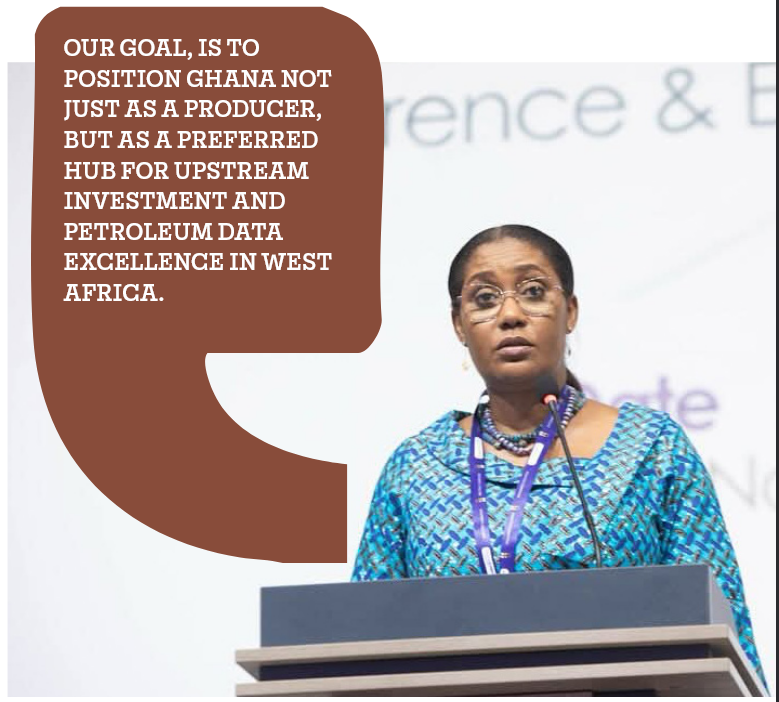
The Cape Town mission included bilateral meetings with major international players such as Energean Energy, Petrobras, Halliburton, and TGS. These engagements focused on new gas development prospects, deepwater exploration opportunities, and the digital transformation of upstream operations. In articulating the Commission’s regulatory posture, Ms. Hardcastle emphasised that Ghana is deliberately shaping an enabling environment grounded in transparent regulation and competitive fiscal terms. “Our goal,” she noted during an investors’ dialogue, “is to position Ghana not just as a producer, but as a preferred hub for upstream investment and petroleum data excellence in West Africa.” Her participation in the high-level “Basins Without Borders” panel reinforced Ghana’s role in advancing regional cooperation and shared resource management.
Strengthening Regulatory Leadership Across Africa’s Energy Landscape
September also saw a deepening of national partnerships. The Commission engaged the Ghana Geological Survey Authority, the University of Ghana’s Earth Science Department, and the Ghana Atomic Energy Commission to strengthen mentorship, research collaboration, and technical capacity-building. These domestic alliances underscored the Commission’s conviction that responsible petroleum development requires robust local expertise, harmonised scientific support, and strong institutional alignment.
Another pivotal moment came in mid-September during Africa Oil Week (AOW), hosted in Accra for the first time in over three decades. Opened by President John Dramani Mahama, the event drew over a thousand investors, industry executives, and policymakers. The Petroleum Commission, led by Ms. Hardcastle, leveraged the platform to highlight Ghana’s deepwater potential, basin development initiatives, and the expanding slate of upstream opportunities—positioning Ghana as a continental thought leader and an anchor for long-term investment flows into Africa.
At the close of September, the Commission hosted Enterprise Singapore’s Executive Director, Mr. Ho Chee Hin, during his first mission to Africa. Singapore’s longstanding commercial footprint in Ghana provided a strong backdrop for the discussions, which centred on upstream challenges, regulatory reforms, and opportunities for Singaporean involvement in FPSO assembly, subsea installations, tie-backs, petrochemical complexes, and fiscal metering systems. The Commission provided detailed briefings on key national projects including GNPC’s Voltaian Basin drilling campaign, Eastern Basin exploratory activities, the Western Enclave development under the Petroleum Hub initiative, and Ghana Gas’s plans for a second gas reprocessing plant and expanded regasification capacity. The visit demonstrated Ghana’s readiness for deeper Asian investment and highlighted Singapore’s unique industrial expertise—particularly within the FPSO and petrochemical manufacturing ecosystem, which accounts for a significant portion of the country’s sectoral output.
Momentum carried into October as regulatory reform became an increasingly central theme in the Commission’s engagements. Acting Deputy CEO Mr. Nasir Alfa Mohammed reaffirmed government’s commitment to wide-ranging reforms, including a review of legislation and fiscal frameworks aimed at revitalising upstream activities. He extended an invitation to Singaporean partners to participate in the Local Content Conference scheduled for early November, where Ghana’s renewed sectoral strategy would be unveiled.
Deepening Investor Confidence and Technical Collaboration
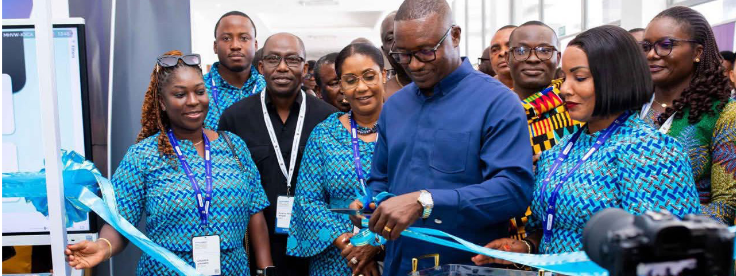
By November, the conversation matured into decisive action when the Local Content Conference and Exhibition opened in Takoradi for three days of sector-wide reflection, investment announcements, and capability mapping. Describing the moment as “defining” for Ghana’s energy future, Ms. Hardcastle welcomed a surge of high-level interest including expressions from three supermajors and a major independent. The conference saw Shell engage in advanced discussions for a South Deep-Water Block, Tullow and Kosmos confirm a combined USD 2 billion investment programme, and ENI sign a USD 1.5 billion Memorandum of Intent to drill new wells and expand subsea infrastructure.
Minister Jinapor delivered a sobering yet galvanising diagnosis of Ghana’s production outlook, noting the decline from 71 million barrels in 2019 to approximately 48 million barrels in 2024/2025. He warned that this was “not just a fall in revenue but a shrinking of opportunities for Ghanaian companies,” attributing the downturn to regulatory inefficiencies, policy inconsistency, and burdensome taxation. In response, a Legislative Review Committee was commissioned to re-examine the fiscal regime and petroleum laws, with a report expected by the end of November. “Our fiscal regime must be competitive and forward-looking,” he declared, arguing that Ghana’s natural resources must serve as instruments for national transformation.
On the technical front, GNPC CEO Kwame Ntow Amoah confirmed that preparations were underway for the first-ever drilling programme in the Voltaian Basin, with GNPC readying itself to assume operatorship. Ghana Gas outlined plans to revitalise the gas sector, expand offtake opportunities, and strengthen the role of gas in the national energy mix. Regional delegations from Nigeria, Mozambique, and The Gambia echoed the importance of shared technical capacity-building and stronger African local content ecosystems.
The second day of the November conference focused on innovation, financing, and the evolution of business models. Panels reinforced the need for data-driven decision-making, enhanced regulator-operator collaboration, and more accessible local financing structures. Industry expert Tony Paul underscored the catalytic role of research and innovation, noting that every thriving petroleum sector must prioritise these pillars deliberately. Financial institutions expressed readiness to support upcoming upstream and midstream projects on the condition that governance and transparency remain consistently strong. By the close of the day, consensus had emerged that exploration revitalisation must align with low-carbon development pathways, renewable energy integration, and broader regional harmonisation.
The final day of the conference delivered a landmark moment with the launch of the In-Country Capacity and Capabilities Catalogue (ICCC), unveiled by Ms. Hardcastle as a transformative tool for the local service industry. She described the catalogue as “a statement of belief in the strength and potential of Ghanaian enterprise,” asserting that it would enhance transparency, build trust, and ensure meaningful Ghanaian participation across the value chain. Operators presented procurement forecasts for 2026 and beyond—including exploration programmes, infrastructure projects, logistics needs, and technology-heavy operations—which were welcomed by local service providers eager for the predictability required to invest wisely and scale competitively. Delegates widely described the conversations as practical and the commitments as real, concluding that Ghana’s upstream outlook appeared brighter than at any point in recent years.
The Commission’s busy November concluded with the Maritime Security Governance Course in Accra, held from the 24th to the 28th, where the rise of maritime threats—piracy, illegal fishing, smuggling, and trafficking—was examined. Delivering remarks on behalf of the Acting CEO, Mr. Nasir Alfa Mohammed reminded participants that Ghana’s maritime space is the heartbeat of the national economy, with over 90 percent of trade moving through its ports. He stressed that maritime insecurity is “not just a security issue, but an economic issue,” and emphasised the need for integrated enforcement, intelligence-sharing, and harmonised protocols aligned with the National Integrated Maritime Strategy.
Positioning for Long-Term Upstream Competitiveness
Together, these developments reflect a Commission operating with renewed clarity and purpose. Whether advancing major international engagements, reshaping regulatory frameworks, strengthening domestic technical foundations, or projecting Ghana’s upstream potential on continental platforms, the Petroleum Commission has signalled a clear commitment to building a competitive, transparent, and investor-ready petroleum sector. With its coordinated approach across government, industry, academia, and international partners, Ghana is steadily positioning itself as a premier hub for responsible upstream development, regional leadership, and long-term energy security.
