CRCC Eyes 1.2-GW Power Plant as Ghana’s Petroleum Hub Shifts from Vision to Bankable Reality
Interest from China’s CRCC Limited in developing a 1.2-gigawatt power plant at Ghana’s Petroleum Hub marks a critical shift in the project’s trajectory, signaling that global capital is beginning to assess the Hub as a bankable, integrated industrial system rather than a distant vision.
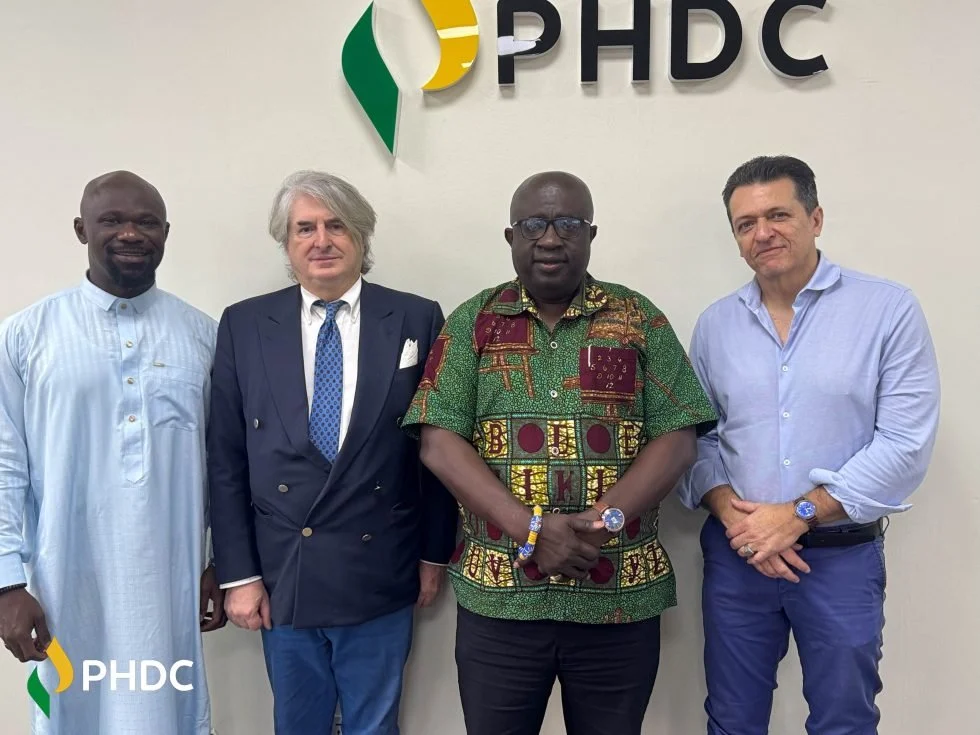
Accra, Ghana | February 10, 2026 - The Petroleum Hub Development Corporation’s long-running courtship of global capital is beginning to yield a more consequential class of interest. CRCC Limited, one of China’s largest state-owned engineering and infrastructure firms, has formally expressed interest in developing a 1.2-gigawatt power plant within Ghana’s planned Petroleum Hub enclave in Jomoro, a move that underscores a quiet but important shift: the Hub is no longer being evaluated as an abstract mega-project, but as an integrated industrial system capable of underwriting its own energy demand.
The proposed power plant, discussed during high-level engagements with PHDC, would serve as a backbone asset for the Hub’s downstream, petrochemical, and logistics ecosystem. At scale, 1.2 GW is not a speculative add-on. It signals industrial intent, the kind that typically precedes refinery complexes, storage farms, and heavy processing infrastructure. For PHDC, it represents validation of a core thesis underpinning the Hub: that energy, industry, and infrastructure must be co-developed if Africa is to escape the commodity export trap.
CRCC’s interest lands at a moment when the Petroleum Hub’s institutional posture has noticeably hardened. Under the leadership of Chief Executive Officer Dr. Toni Aubynn, PHDC has framed 2026 as a “year of action,” a declaration backed by a more synchronized board-management front and a sharper emphasis on execution over promotion. The messaging has been consistent across platforms: Ghana’s most credible path to economic transformation lies in integrated natural resource processing, not fragmented extraction.
That philosophy has increasingly shaped PHDC’s deal flow. In recent months, the Corporation has deepened engagement with Chemexa Petrochemical Trading and its partners, culminating in a memorandum of understanding with Chemexa and the Afdat Group of Companies for the construction of petroleum storage tanks within the Hub. The Chemexa engagement, which follows earlier structuring discussions, is widely viewed as foundational. Storage is not headline-grabbing, but it is indispensable. Without it, refineries stall, trading hubs fail to clear, and power projects lack fuel security.
The CRCC interest builds on this groundwork. Large-scale power generation inside the Hub would de-risk downstream investments by stabilizing energy supply and pricing, while anchoring demand for gas, refined products, and petrochemical feedstocks. In practical terms, it moves the Hub closer to being a self-contained industrial city rather than a collection of aspirational plots.
Beyond energy, PHDC’s strategy has expanded decisively into real estate and enabling infrastructure, a recognition that industrial hubs do not function in isolation from human settlement. The Tema Development Corporation has signaled strong interest in developing residential settlements within the Petroleum Hub zone, a move that aligns with PHDC’s own on-the-ground interventions in Jomoro. The Corporation has already commenced major water and electricity projects in the district, laying the groundwork for workforce accommodation, services, and social infrastructure.
These steps matter to investors as much as power plants and storage tanks. Large industrial projects fail as often from social and logistical neglect as from financing gaps. By sequencing utilities, housing, and industrial assets together, PHDC is attempting to avoid the hollow-zone syndrome that has plagued similar projects elsewhere on the continent.
CRCC’s approach also sits within a broader constellation of partnerships that are steadily giving the Petroleum Hub institutional density. PHDC has signed a GH₵300 million agreement with Mannschaft for early works, while strategic engagements with Surbana Jurong have strengthened the project’s master planning and technical architecture. Together with the Chemexa-Afdat MoU, these agreements form the Hub’s first serious scaffolding, not final investment decisions, but credible precursors to them.
What distinguishes the current phase is not the number of MoUs, but their thematic coherence. Power, storage, planning, utilities, and housing are advancing in parallel. That coherence reflects Dr. Aubynn’s public advocacy on regional platforms, including the Africa Trade Summit, where he has argued that Africa’s economic future depends on integrated minerals and energy markets rather than siloed national projects. The Petroleum Hub, in this framing, is less a Ghanaian vanity project than a regional industrial node.
Still, interest does not equal commitment. CRCC’s expression of interest will ultimately be tested against Ghana’s regulatory clarity, land acquisition processes, and the Hub’s ability to move from preparatory works to bankable project structures. Power projects of this scale demand long-term offtake certainty, fuel supply guarantees, and grid or captive-use clarity. PHDC’s challenge now is to translate strategic alignment into executable commercial frameworks.
Yet the direction of travel is increasingly difficult to ignore. With CRCC at the table, alongside Middle Eastern traders, global planners, and domestic development institutions, the Petroleum Hub is attracting a calibre of attention that suggests patient capital is beginning to see beyond the headline $60 billion figure to the underlying industrial logic.
For PHDC, the message is clear. The market is watching less for declarations and more for delivery. If 2026 is indeed to be the year of action, the coming months will determine whether Ghana’s most ambitious industrial project can convert sustained interest into irreversible momentum.
