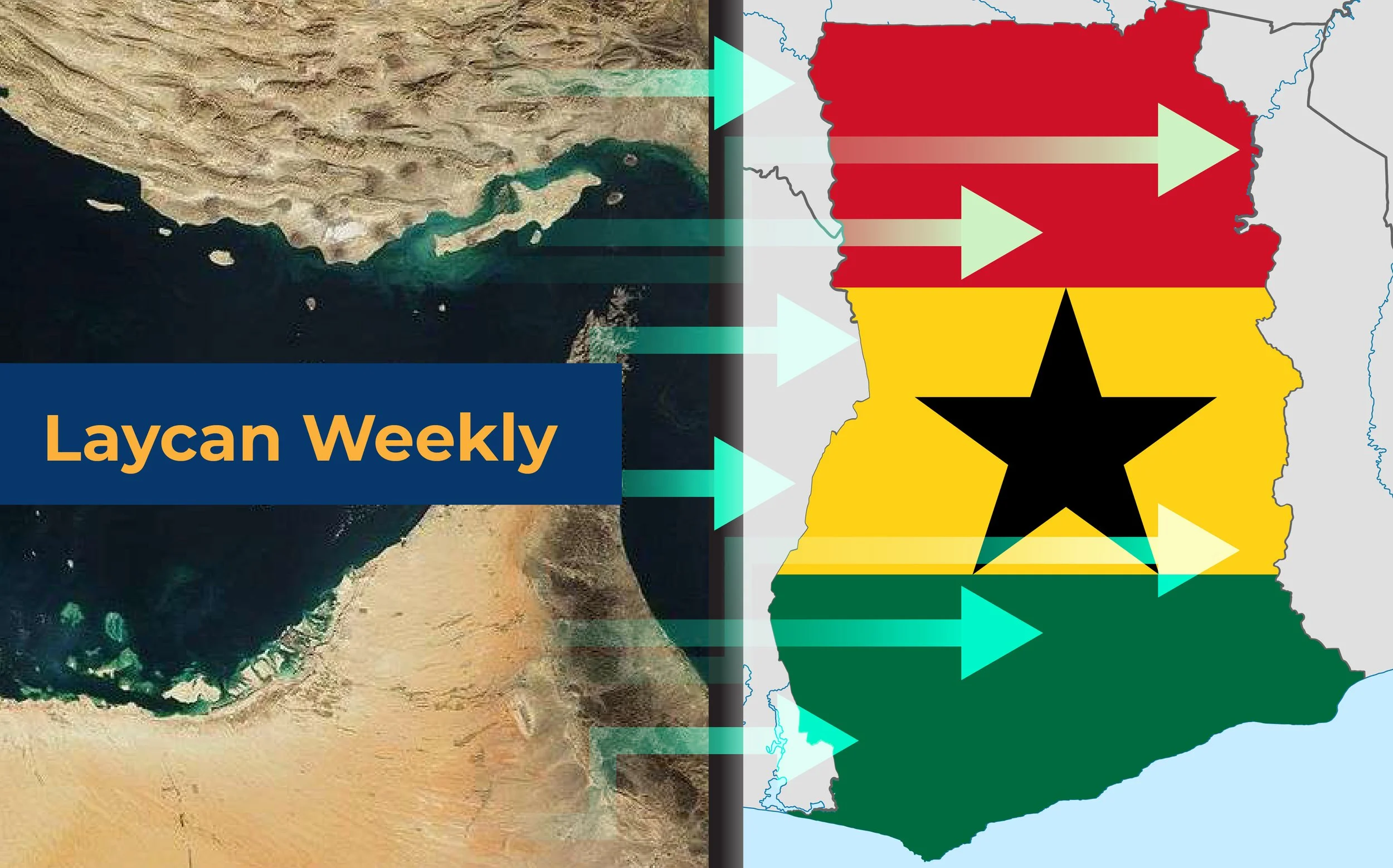
Hormuz to Accra: The Shortest Distance in Energy
The closure of the world's most critical oil chokepoint sent Brent to a three-year high and exposed every import-dependent economy in West Africa to an immediate fiscal reckoning.
There are weeks in the long history of oil markets when everything changes at once. The third week of march was one of them. It began with Brent crude already elevated, having surged from $71 a barrel on 27 February to $94 by 9 March following the onset of US and Israeli military strikes on Iran that began on 28 February. On Monday 9 March, intraday trading pushed Brent futures to a session high of $119.50, the highest price since July 2022, as markets absorbed the full weight of what the Strait of Hormuz closure meant for global supply. By Thursday 12 March, Brent closed at $100.46 and WTI at $95.73. The IEA's March Oil Market Report, published that same day, noted that Brent was trading around $92 at the time of writing on Thursday morning before recovering, with prices moving back above $100 by Friday 13 March as markets weighed the emergency stock release against the continued reality of a closed Strait. The IEA described what was unfolding as the largest supply disruption in the history of the global oil market. For countries like Ghana, which import refined petroleum products and price them against a currency that tracks every dollar move, this was not an abstraction. It was a direct fiscal event.
Domestic Fuel Prices Under Pressure
Ghana’s National Petroleum Authority announced new fuel price floors on 13 March 2026 for the second pricing window of March, covering 16 to 31 March. Petrol rises from GH¢10.46 to GH¢11.57 per litre. Diesel climbs from GH¢11.42 to GH¢14.35 per litre. Global pressure drives the move. Brent crude trades above $100 through Thursday and Friday. Strong dollar demand tightens liquidity in the interbank market and weakens the cedi. These forces push pump prices upward across the market. The direction of fuel prices now points firmly higher. The current average electricity tariff of 15 cents per kilowatt-hour, cited in the government's renewable energy announcement, speaks to the baseline cost burden that households and industry carry before any crude-driven passthrough reaches them.
Energy Minister Dr. John Abdulai Jinapor's announcement to phase out imported LPG cylinders and retool the Ghana Cylinder Manufacturing Company tells you something important about the government's chosen response. It is not subsidy. It is substitution. The IEA's March report noted that reduced LNG flows through the Strait had already caused natural gas prices in Europe and Asia to rise sharply, and that LPG supply for cooking and heating across East Africa and South Asia faced direct disruption. Ghana, a significant LPG importer, sits squarely in that exposure zone.
Global Crude Benchmarks Shift
The speed and scale of what happened in the week's opening days was remarkable even by the volatile standards of modern oil markets. The EIA's Short-Term Energy Outlook, published on 10 March, confirmed Brent had settled at $94 a barrel on 9 March, up roughly 50 percent from the start of the year and the highest level since September 2023. Monday's intraday spike to $119.50 represented panic pricing at its most concentrated. Gulf producers cut output by at least 10 million barrels per day, and the IEA projected total March supply would fall by 8 million barrels per day, a monthly decline of historic proportions. The IEA coordinated a release of 400 million barrels from emergency stockpiles on 11 March, the largest such intervention in history, with the United States contributing 172 million barrels from its Strategic Petroleum Reserve. Markets absorbed the announcement and moved higher anyway.
Regional Energy Dynamics
If the global picture was one of shock and attempted institutional response, the Nigerian picture was one of a system failing quietly from within. On 12 March, gas suppliers cut deliveries to power plants over a debt that Punch Nigeria reported at N3.3 trillion owed by Nigerian Bulk Electricity Trading, with total receivables owed to generation companies standing at N6.8 trillion. Gas supply reached only 692 million standard cubic feet per day against a system requirement of 1,629.75 million, a shortfall of 42.5 percent. Eleven distribution companies were sharing just 3,053 megawatts of available generation as of 11 March. The Association of Power Generation Companies projected total debt reaching N7 trillion by end of March, accruing at N200 billion every month. This is not a story about oil prices. It is a story about payment systems. And it is the kind of story that does not resolve itself through any amount of emergency reserve releases or diplomatic intervention. West Africa's two largest economies were both under severe energy stress that week, but the nature of the stress could not have been more different. One was imported. The other was entirely self-inflicted.

Global Gas and LNG Market
The EIA's Short-Term Energy Outlook projected Henry Hub natural gas averaging around $3.80 per MMBtu in 2026, a figure that reflected the dramatic unwinding of January's extreme cold-driven spike to $30.72 per MMBtu. The US benchmark had shed the overwhelming bulk of that winter premium by March, with storage levels normalising ahead of expectations. American LNG export costs averaged $3.63 per MMBtu across 2026. While reduced LNG flows through the Strait of Hormuz pushed European and Asian gas prices higher during the week, US domestic pricing remained relatively insulated. The IEA's Electricity 2026 report, published on 12 March, projected global electricity demand growing at more than 3.5 percent annually through 2030, with renewables alongside nuclear reaching 50 percent of the global generation mix by decade's end. The divergence between oil markets tightening violently and gas markets loosening steadily is not a short-term anomaly. It reflects deeper structural differences in how each commodity is produced, stored and traded. For policymakers in Accra navigating long-term supply negotiations, the signal is clear: commodity-specific diversification matters far more than spot timing.
Ghana Energy Strategy
Against a backdrop of global disruption, Ghana produced an unusually concentrated week of policy action.. On 12 March, Ghana and Switzerland formally authorised a biogas project under Paris Agreement Article 6.2, the country's second bilateral carbon credit transaction under that mechanism. On 13 March, the Energy Minister announced the phase-out of imported LPG cylinders, a policy decision whose urgency the IEA's own report that week had made plainly visible. Energy Minister Dr. Jinapor was also confirmed as a speaker at African Energy Week 2026 in Cape Town, alongside ministers from Algeria, Senegal, Zambia and Niger.
The Path Forward
History has a way of concentrating itself into short periods. The third week of March 2026 was one of those periods. Brent went from $71 on 27 February to an intraday high of $119.50 within eleven days, closed Thursday at $100.46, and held above $100 through Friday as the IEA's emergency intervention competed with the reality of a Strait that remained closed. The IEA called it the largest supply disruption in the history of the global oil market. For Ghana, the policy response across the week was genuine in its ambition. Renewable targets, LPG localisation, carbon finance activation, bilateral diplomatic engagement: these are the instruments of a country attempting to build structural distance between itself and the next price shock. The gap that remains is between announcement and execution. Nigeria's grid crisis offers the harder lesson. A country with significant hydrocarbon endowment and decades of infrastructure investment found itself in the dark not because of what happened in the Strait of Hormuz, but because of accumulated payment failures that no emergency stock release can fix.
For Ghana, the path forward is not simply one of more megawatts or better tariff structures. It is one of institutional credibility: ensuring that the systems built to deliver energy actually get paid when the oil price spikes and the pressure finds every weak point in the architecture.