Petroleum Commission Courts Capital and Consolidates Local Content Push at APD and SAIPEC 2026
At two of Africa’s most consequential economic and energy platforms—the Africa Prosperity Dialogues 2026 in Accra and the Sub-Saharan Africa International Petroleum Exhibition and Conference 2026 in Lagos—the Petroleum Commission mounted a coordinated campaign to reposition Ghana’s upstream sector. The message was disciplined and deliberate: restore exploration momentum through regulatory certainty and frontier acreage promotion, while entrenching indigenous participation through strengthened local content rules and structured financing. In a capital-constrained hydrocarbon market, Ghana is signalling that investor confidence and domestic value retention will advance in tandem—not in tension.
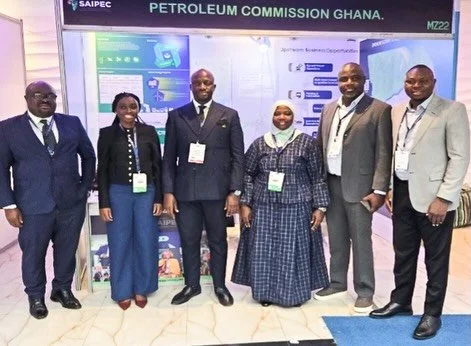
Accra, Ghana | February 19, 2026 - Ghana’s upstream regulator is sharpening a two-pronged strategy: court capital abroad while consolidating domestic capacity at home. At the 2026 editions of the Africa Prosperity Dialogues 2026 in Accra and the Sub-Saharan Africa International Petroleum Exhibition and Conference 2026 in Lagos, the Petroleum Commission positioned itself as both investment ombudsman and local content enforcer—an institutional duality that will define the next phase of Ghana’s upstream reset.
The message was consistent across platforms: regulatory stability and legislative clarity are prerequisites for fresh exploration capital; structured local participation is non-negotiable for long-term value retention.
Investment Diplomacy in Lagos
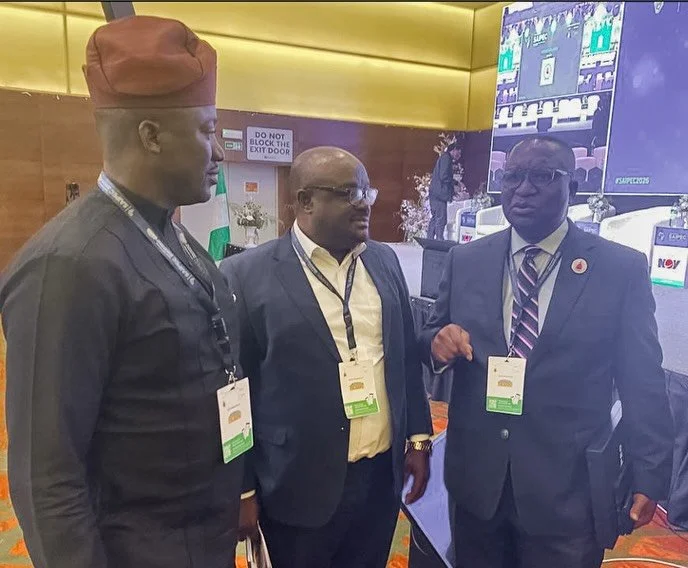
In Lagos, at SAIPEC’s tenth anniversary gathering, a delegation led by Acting Deputy Chief Executive Officer Nasir Alfa Mohammed made a calibrated pitch to a continent-wide audience of regulators, operators, financiers and service companies.
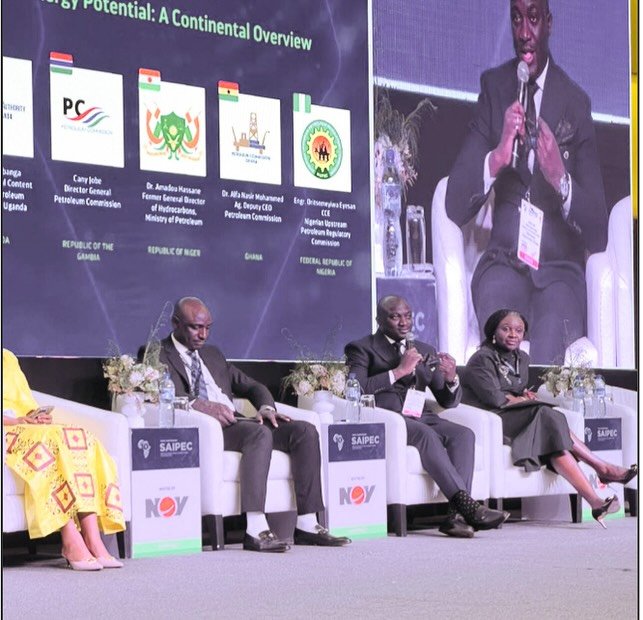
Addressing a high-level regulatory panel on unlocking Africa’s energy potential, Mr Mohammed traced Ghana’s upstream arc since the 2007 commercial oil discovery—an inflection point that compelled rapid institutional development. He argued that Ghana’s post-discovery reforms have centred on institutional strengthening, policy consistency and targeted legislative adjustments designed to preserve investor confidence in a volatile global energy environment.
The emphasis was unmistakable: exploration must be revived.
Ghana’s sedimentary acreage—offshore and onshore—remains underexplored relative to its geological potential. Particular attention was directed to the Voltaian Basin, an onshore frontier covering approximately 103,600 square kilometres across multiple regions and spanning nearly a third of the country’s landmass. Long identified as a strategic exploration priority, the basin is being reframed as a partnership opportunity for technically credible and financially robust investors.
This is not rhetorical optimism. The Commission’s recent engagement with seismic data players and renewed upstream diplomacy, including high-profile international platforms, form part of a broader effort to reposition Ghana as a stable and competitive destination for frontier capital. In Lagos, that narrative was reinforced through exhibition engagements with investors, financiers and technology providers.
Industry discourse at SAIPEC also underscored the growing salience of African capital pools. Institutions such as the African Export-Import Bank and the newly established African Energy Bank were highlighted as potential catalysts for African-led project financing—an important counterweight to tightening global capital for hydrocarbons.
Yet Ghana’s pitch was not solely about acreage. It was about governance architecture: predictable regulation, enforceable contracts and a rules-based operating environment. For investors recalibrating portfolios amid energy transition pressures, that institutional ballast matters as much as subsurface prospectivity.
Local Content as Industrial Policy
If Lagos was about capital inflows, Accra was about value retention.
At the Africa Prosperity Dialogues 2026, convened by the Africa Prosperity Network under the auspices of President John Dramani Mahama and represented by Vice President Jane Naana Opoku-Agyemang, the Commission leaned into the industrial policy dimension of upstream governance.
Speaking at an oil and gas breakfast session focused on integrating women, youth and small and medium-sized enterprises into Africa’s value chains under the African Continental Free Trade Area framework, the Commission’s Director for Economics and Local Content, Kwaku Boateng, situated Ghana’s local content regime within a broader continental integration agenda.
The Commission’s position is explicit: upstream hydrocarbons must function as a platform for skills transfer, enterprise development and domestic capital formation—not merely fiscal receipts.
That posture is anchored in law. The Petroleum (Local Content and Local Participation) Regulations, 2013 (Legislative Instrument 2204), were amended by Legislative Instrument 2435 to create defined “protected zones” reserved for Indigenous Ghanaian Companies. An Indigenous Ghanaian Company is defined, in regulatory terms, as an entity incorporated in Ghana with at least 51 per cent Ghanaian equity ownership and a minimum of 80 per cent Ghanaian representation at executive and senior management levels.
The amendment was a deliberate intervention to mitigate structural asymmetries between well-capitalised international oil companies and domestic firms confronting high technical and financial entry barriers. By ring-fencing specific operational scopes, the Commission has sought to recalibrate competitive dynamics without undermining efficiency or safety standards.
Crucially, local content is being paired with financial architecture. The Local Content Fund—domiciled with the Bank of Ghana and to be disbursed through an accredited financial institution—is designed to provide concessionary financing, including working capital, to Indigenous Ghanaian Companies and vulnerable groups such as women and persons with disabilities. The Fund also envisages support for internationally recognised certifications and institutional capacity building.
This is an attempt to move beyond declaratory local content to bankable local participation.
Continental Framing, Domestic Execution
The Africa Prosperity Dialogues—run by the Africa Prosperity Network as part of a broader Agenda 2063-aligned integration vision—provided a continental lens through which Ghana’s upstream policies were presented. The theme of empowering small and medium-sized enterprises, women and youth within Africa’s single market framework intersects directly with the African Continental Free Trade Area’s promise of regional value chains.
For Ghana, the argument is that a well-structured local content regime can coexist with, and even reinforce, cross-border energy integration. Domestic capacity building need not be protectionist if it enhances competitiveness and technical depth.
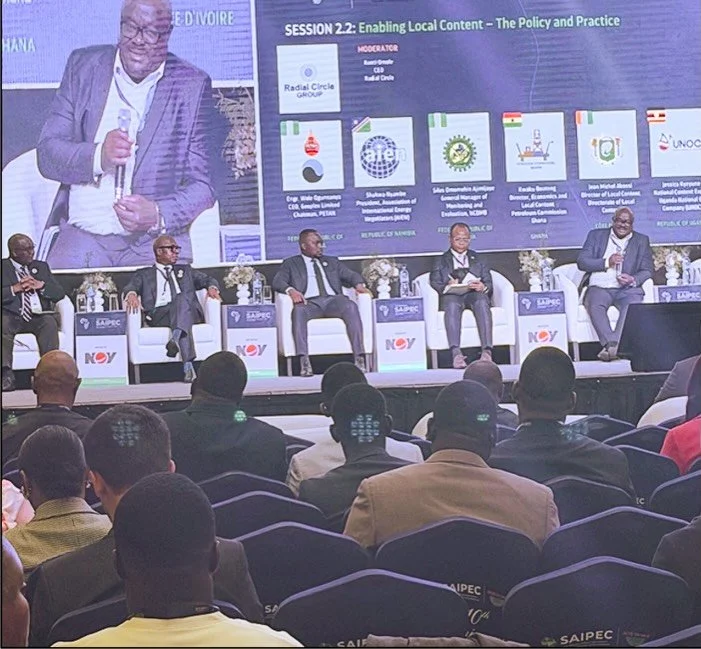
At SAIPEC, that continental perspective was mirrored by the launch of the African Local Content Association, aimed at coordinating policy approaches across energy markets. Ghana’s experience—often cited for its relatively detailed compliance architecture—was implicitly positioned as a reference model for peer regulators.
The policy challenge, however, lies in execution. Protected scopes must not degenerate into rent-seeking enclaves; concessionary finance must be disbursed transparently and recovered prudently; investor assurances must translate into signed petroleum agreements and drilled wells.
The Commission’s recent engagements—from seismic collaborations to strategic international outreach—suggest awareness of that execution risk. Rebuilding exploration momentum in a capital-constrained global environment will require more than conference diplomacy. It will demand sustained data acquisition, competitive fiscal terms and disciplined regulatory timelines.
A Calculated Balancing Act
Taken together, the Commission’s dual presence in Accra and Lagos illustrates a calibrated balancing act.
On one flank: attract fresh capital to underexplored basins, including the Voltaian frontier, by emphasising policy continuity and regulatory certainty.
On the other: deepen indigenous participation through targeted legislative amendments and structured financial support mechanisms.
For Ghana’s upstream sector—navigating maturing offshore fields, global energy transition headwinds and fiscal pressures—that balance is not optional. It is structural.
The Petroleum Commission’s 2026 conference diplomacy signals intent. The harder test lies ahead: converting platform statements into drilling programmes, certified local contractors and measurable value retention across the hydrocarbon value chain.
In an era where capital is selective and domestic constituencies are impatient, Ghana’s upstream regulator is staking its credibility on delivering both.
