NPA Moves to Calm Market as Fuel Supply Fears Ripple Through Ghana’s Downstream Sector
A swirl of global oil market tensions, operational questions within Ghana’s fuel distribution system, and speculation over product shortages has prompted a wave of industry statements in recent days. At the centre of it all, the National Petroleum Authority has stepped forward to calm the waters—assuring the public that Ghana holds adequate fuel stocks and that the country’s petroleum supply chain remains stable despite the noise reverberating across the downstream sector.

Accra, Ghana | March 11, 2026 - Ghana’s downstream petroleum regulator has stepped in to steady market nerves after days of speculation over potential fuel shortages, assuring the public that the country’s fuel supply chain remains intact.
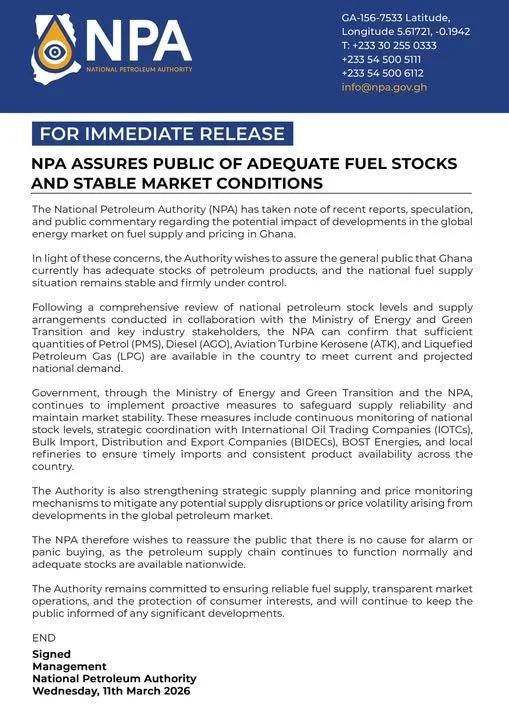
In a statement issued on Wednesday, March 11, the National Petroleum Authority (NPA) said Ghana holds sufficient petroleum stocks and that supply conditions remain stable despite growing public concern triggered by global energy market tensions and reports of disruptions in the local distribution chain.
“The Authority wishes to assure the general public that Ghana currently has adequate stocks of petroleum products, and the national fuel supply situation remains stable and firmly under control,” the NPA said.
The reassurance comes amid heightened volatility in global oil markets following tensions in the Strait of Hormuz—one of the world’s most critical oil transit chokepoints—that have rattled supply expectations and pushed crude prices upward in recent weeks.
Those global anxieties have filtered into Ghana’s domestic market in recent days, where rumours of supply constraints began circulating after some Oil Marketing Companies (OMCs) reported temporary product availability challenges at certain service stations.
A chain reaction of statements
The first public signals of strain emerged earlier this week when the two leading OMCs in the country, GOIL and Star Oil, issued notices to customers explaining supply disruptions at some retail outlets. Some companies linked the difficulties to operational challenges with the Integrated Customs Management System (ICUMS), the digital platform used to process petroleum product clearances and related trade documentation, which slowed the movement of fuel products from depots to retail stations.
But the operators of the ICUMS platform moved swiftly to contest that narrative.
In a statement dated March 9, Ghana Link Network Services Ltd., which operates the system, described the allegations as inaccurate.
“Ghana Link wishes to state unequivocally that these claims are false, misleading, and wholly without basis,” the company said.
According to Ghana Link, the platform “has remained fully operational, including throughout the period referenced in the said statement,” adding that “at no point has the system suffered any outage of the nature being alleged.”
The company further clarified that internal checks suggested the operational issue cited by some market players did not originate from ICUMS.
“Our checks indicate that the operational challenge in question does not relate to ICUMS, but rather to the Enterprise Relational Database Management System (ERDMS) of the NPA,” the statement noted.
Ghana Link also called on Star Oil to “immediately withdraw the statement and issue an unqualified public apology for putting false and misleading information into the public domain.”
Industry bodies step in
As the claims and counterclaims circulated, downstream industry groups moved to prevent market speculation from escalating.
The Chamber of Bulk Oil Distributors (CBOD) on March 9 rejected suggestions that importers were hoarding petroleum products in anticipation of price increases in the upcoming pricing window beginning March 16.
“These claims are categorically false and mischievous to say the least,” the chamber said in a statement.
CBOD added that Bulk Import, Distribution and Export Companies (BIDECs) have continued to supply fuel across the country.
“BIDECs have been supplying products at the various fuel depots dotted across the country since the first window (1st – 15th) in March 2026,” the chamber said, noting that distribution data from the NPA’s ERDMS system shows that “product distribution is ongoing and loading patterns consistent with past trends.”
The industry body also stressed that supply commitments to Oil Marketing Companies remain intact under existing contracts.
Meanwhile, the Chamber of Oil Marketing Companies (COMAC) also issued a communication indicating that the loading challenges linked to the ICUMS/ERDMS interface had been resolved.
Regulator seeks to steady the market
Against that backdrop, the NPA’s intervention appears aimed at closing the loop on a series of developments that had begun to feed public anxiety about fuel availability.
Following what it described as a comprehensive review conducted with the Ministry of Energy and Green Transition and industry stakeholders, the regulator said supplies of petrol, diesel, aviation turbine kerosene and LPG remain sufficient to meet demand.
“Sufficient quantities of Petrol (PMS), Diesel (AGO), Aviation Turbine Kerosene (ATK), and Liquefied Petroleum Gas (LPG) are available in the country to meet current and projected national demand,” the Authority said.
The NPA added that government agencies and industry players are maintaining continuous oversight of stock levels and coordinating with international oil trading companies, Bulk Import, Distribution and Export Companies, BOST Energies and local refineries to ensure timely imports and product availability nationwide.
“These measures include continuous monitoring of national stock levels, strategic coordination with International Oil Trading Companies (IOTCs), Bulk Import, Distribution and Export Companies (BIDECs), BOST Energies, and local refineries to ensure timely imports and consistent product availability across the country,” the Authority said.
No cause for panic buying
For consumers, the regulator’s message was clear: there is no supply crisis.
“The NPA therefore wishes to reassure the public that there is no cause for alarm or panic buying, as the petroleum supply chain continues to function normally and adequate stocks are available nationwide,” the statement said.
With geopolitical risks still hovering over global oil markets and pricing adjustments looming in the next domestic fuel pricing window, the coming weeks will test whether Ghana’s downstream sector can maintain the delicate balance between market stability and external shocks.
For now, the regulator insists the system is holding.
