IES Calls for Stronger NPA Enforcement as Ghana’s Fuel Price War Deepens
Ghana’s fuel price war has drawn a sharp regulatory warning, with the Institute for Energy Security urging the NPA to clamp down on below-floor pricing and selective discounts that it says threaten market discipline, consumer equity, and the credibility of the downstream pricing regime.
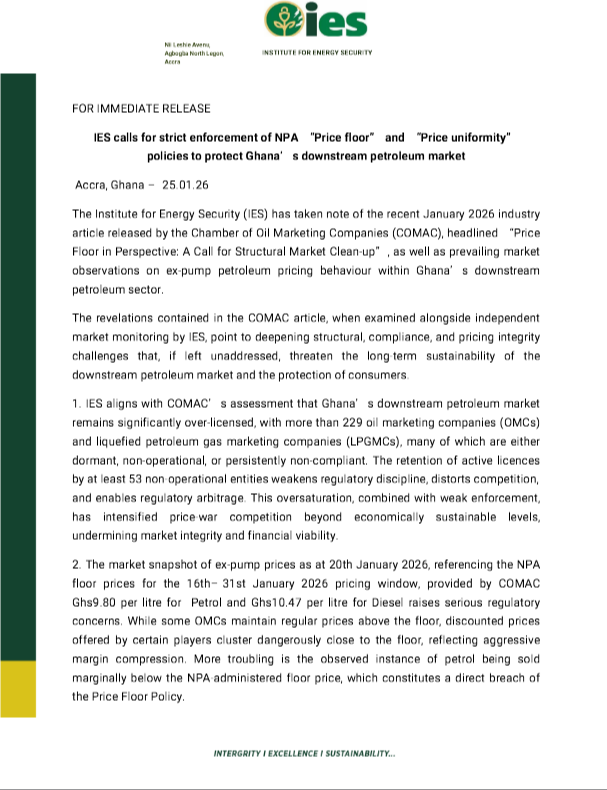
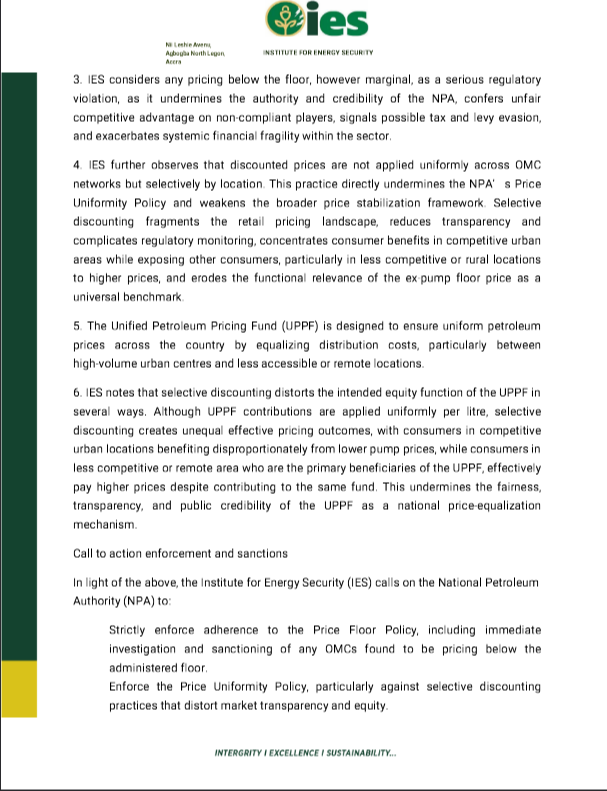
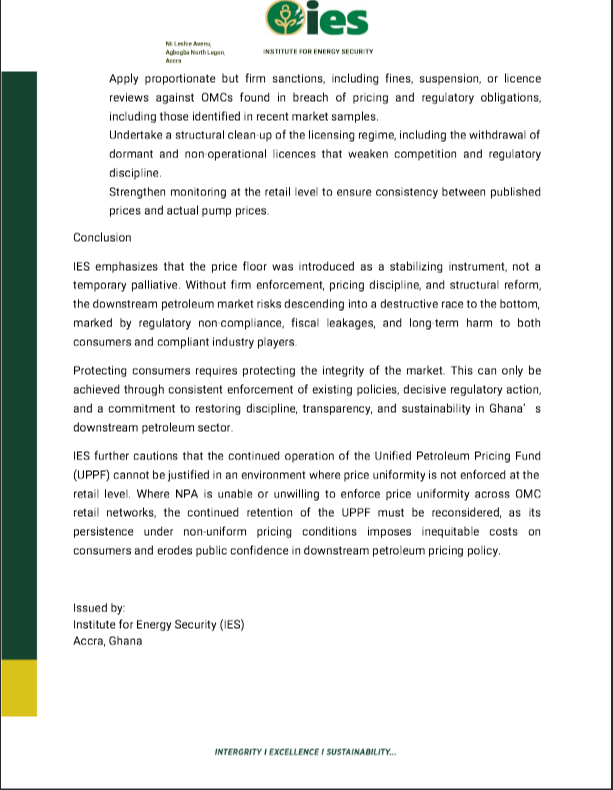
Accra, Ghana | January 25, 2026 - The Institute for Energy Security (IES) today urged the National Petroleum Authority (NPA) to strictly enforce existing Price Floor and Price Uniformity policies in Ghana’s downstream petroleum market, warning that current pricing behaviour threatens market integrity and consumer equity.
In a statement responding to recent industry developments and market data, IES said evidence of below-floor pricing and selective discounts across retail outlets undermines the authority of the NPA, distorts competition, and weakens public confidence in regulated pricing mechanisms.
IES highlighted that some oil marketing companies (OMCs) have been selling petrol marginally below the NPA-administered floor price, a practice it classified as a serious regulatory violation that confers unfair competitive advantage and signals potential tax and levy compliance issues.
The think tank also raised concerns about selective discounting, where lower prices are applied in competitive urban locations but not uniformly across networks, contravening the NPA’s price uniformity framework. According to IES, this practice erodes the intended equity function of the Unified Petroleum Pricing Fund (UPPF) — which is designed to equalize distribution costs nationwide — by creating unequal effective pricing outcomes for consumers.
The Institute supported industry assessments that Ghana’s downstream market remains over-licensed and weakly enforced, with many dormant or non-compliant players contributing to unsustainable pricing competition.
IES called for the immediate investigation and sanctioning of any OMCs found to be pricing below the regulated floor, alongside firm enforcement of the price uniformity policy to curb selective discounting practices. The Institute urged the application of proportionate but meaningful sanctions, including fines and licence reviews, against entities in breach of pricing and regulatory obligations. It also pressed for a structural clean-up of the licensing regime to remove dormant and non-operational players, and for strengthened monitoring at the retail level to ensure alignment between published prices and actual pump prices.
The Institute reiterated that the price floor is intended as a stabilizing mechanism, and that without firm enforcement and structural reform, the market risks a race to the bottom — with potential long-term harm to both consumers and compliant industry participants.
IES also cautioned that the continued operation of the UPPF cannot be justified if price uniformity is not upheld, as its current application imposes inequitable costs on consumers.
This call comes against the backdrop of an unprecedented slide in pump prices — roughly 30 percent since December 2025 — that has pushed petrol into single digits for the first time since 2022 and sparked a ferocious market share battle among oil marketing companies (OMCs). In that context, sector pressure points have exposed fault lines in regulatory adherence that extend well beyond headline price quotes into the underlying mechanics of regulated market order.
The Chamber of Oil Marketing Companies (COMAC) has reaffirmed support for the price floor, calling for its enforcement, even as the sector’s largest player — Star Oil — suspended its membership of the chamber in protest over how dissenting views have been handled. Consumer advocacy voices, for their part, have mounted parallel criticisms, arguing that the floor artificially restricts price competition and denies consumers the full benefit of global price and exchange rate trends.
Full details of the press release below: