GOIL’s Balancing Act: Profit Holds as Expansion Drive Tests Liquidity
GOIL’s latest numbers read like a company in motion rather than in pause. Profit held steady, assets expanded, and strategic investments deepened, even as revenue softened and liquidity ran tight. The picture is of a state marketer leaning into growth under new management, building long-term capacity while walking a narrow working-capital tightrope that will define its next phase.
Accra | February 1, 2026 - Ghana Oil Company Limited (GOIL PLC) enters 2026 looking less like a static state marketer and more like a company mid-stride in a capital-heavy transition. Its latest unaudited 2025 statements show a business preserving profitability while stretching its balance sheet to fund expansion, a posture that signals managerial assertiveness but demands tight financial discipline.
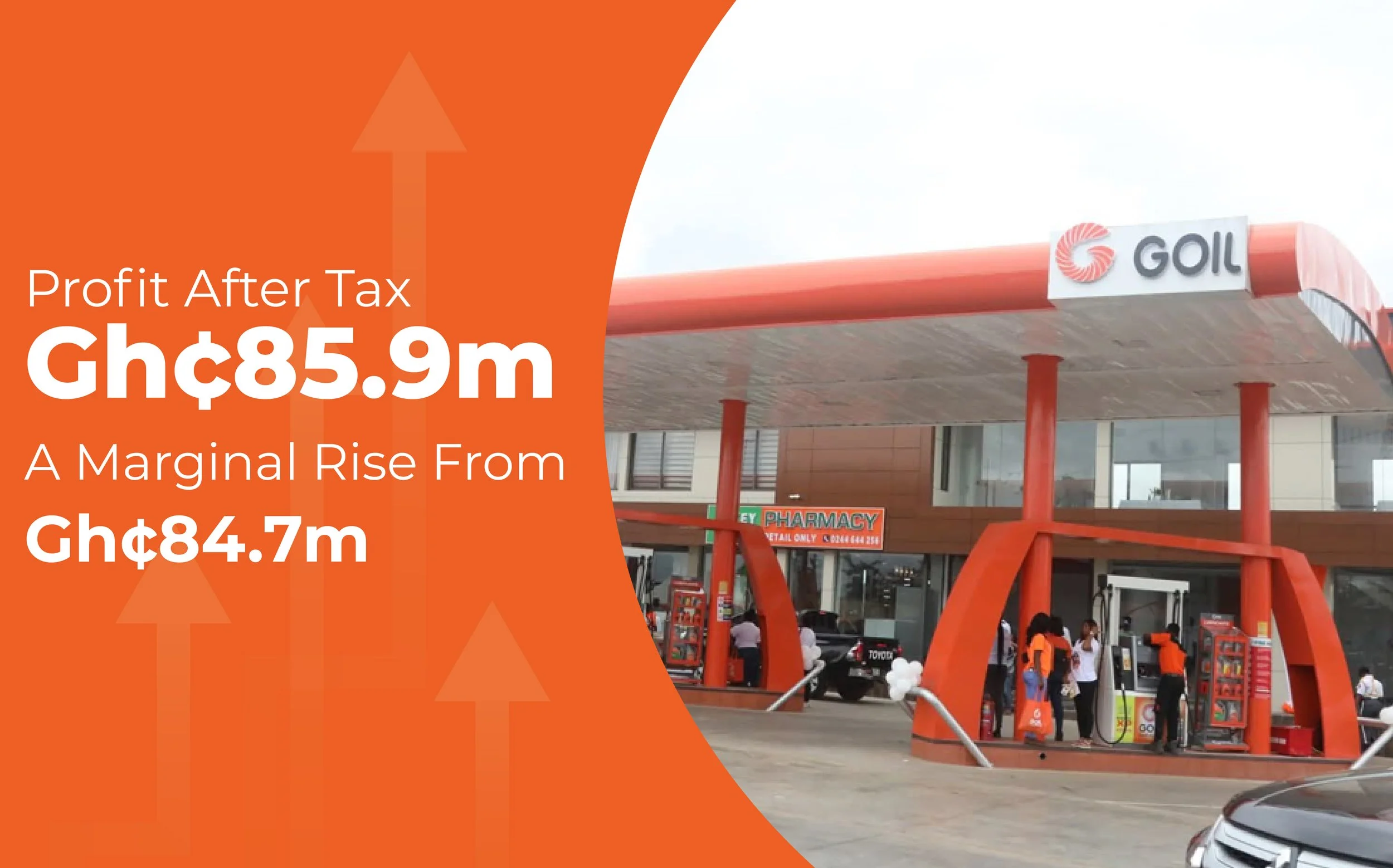
Group profit after tax edged up to GH¢85.9 million, a marginal rise from GH¢84.7 million the prior year, even as revenue retreated roughly 12 percent to GH¢17.1 billion. The divergence between softer top-line performance and stable earnings suggests cost controls and margin management played a decisive role in cushioning the income statement.
Where the story gathers momentum is on the balance sheet. Total assets expanded by more than GH¢419 million to GH¢5.23 billion, reflecting a clear investment tilt under the company’s current leadership. Fixed asset additions alone reached GH¢234.8 million, pointing to network strengthening, infrastructure positioning, and long-term operational capacity rather than short-term trading emphasis.
Yet the expansion carries visible financial weight. Accounts payable climbed sharply to GH¢3.4 billion, up from GH¢2.63 billion, indicating heavier reliance on supplier and trade credit. Short-term loans fell significantly, from GH¢623.3 million to GH¢274.3 million, which partially offsets the pressure, but liquidity remains the central tension in the numbers.
The cash flow statement underlines this strain. Group cash and cash equivalents stood at GH¢1.69 million, set against a GH¢320.68 million bank overdraft. This structure is not uncommon for downstream marketers operating in thin-margin, high-volume environments, but it places execution risk squarely on working capital management, inventory cycles, and receivables discipline.
Strategically, GOIL continues to deepen its industrial footprint beyond conventional retail marketing. Its 60 percent stake in African Bitumen Terminal Limited (ABTL), a joint venture with Côte d’Ivoire’s Société Multinationale de Bitumes, represents a GH¢264.3 million combined equity and shareholder loan investment. Accounted for under the equity method, the venture positions GOIL within regional bitumen logistics and infrastructure supply chains, a segment tied closely to construction and road development demand.
Earnings per share remained effectively flat at GH¢0.215, reinforcing the picture of stability rather than breakout growth. Still, the financial architecture suggests management is prioritizing asset build-out and strategic positioning over immediate cash comfort.
GOIL itself maintains confidence in the integrity of its disclosures, stating the financials contain no misleading or omitted material facts to the best of its knowledge. For observers, the takeaway is not distress but direction: a state-linked marketer pressing forward with expansion while operating inside a narrow liquidity corridor.
The year ahead will test how efficiently that enlarged asset base converts into cash flow strength. If working capital controls hold and new investments mature on schedule, 2025 may be remembered less as a year of flat earnings and more as the hinge point in GOIL’s operational re-scaling.
