
From Coventry to Accra: How UK-Ghana Technical Diplomacy Is Starting to Rewire the Economics of EV Batteries
In Coventry’s industrial heartland, three Ghanaian engineers stepped into the machinery of Europe’s battery future. What unfolded was more than a month of technical immersion at the UK Battery Industrialisation Centre — it was a calculated move in Ghana’s bid to localise the most expensive component of electric vehicles. With batteries accounting for over 60 per cent of EV costs and Ghana importing every single pack, the UK–Ghana JET-backed training marks the debut of an inflection point: a shift from assembling vehicles to mastering the technology that determines who captures value in the transport transition.

Coventry, United Kingdom | February 13, 2026 - In a cavernous production hall in Coventry, three Ghanaian engineers stood at the fault line between laboratory theory and industrial scale. For one month in August 2025, under the auspices of the UK–Ghana Partnership for Jobs and Economic Transformation (JET), the Wahu Mobility team immersed themselves in the practical mechanics of battery pack design, cell integration, testing protocols and pilot-line manufacturing at the UK Battery Industrialisation Centre (UKBIC) — the United Kingdom’s national facility for de-risking battery production.
For Ghana, which currently imports 100 per cent of its electric vehicle (EV) batteries, the significance extends well beyond a training exchange. It is an early but deliberate move in a larger industrial wager: that battery capability, not merely vehicle assembly, will determine who captures value in the coming transport transition.
The Cost Centre That Defines the Market
Battery packs account for more than 60 per cent of the total cost of an EV. In emerging markets, import dependence compounds that burden through logistics, tariffs and currency volatility. Ghana’s EV ecosystem — though still nascent — reflects that constraint. Every pack powering the country’s growing fleet of electric two- and three-wheelers is sourced offshore, predominantly from Asia.
If even a portion of that value chain were localised, industry players estimate retail prices could fall materially, improving affordability in a market where upfront cost remains the principal barrier to adoption.
The numbers underscore the urgency. The transport sector accounts for 8.7 gigatonnes of CO₂ emissions globally — roughly 23 per cent of energy-related emissions — with road vehicles responsible for the bulk. Emissions have risen faster than in most other end-use sectors, and to align with a net-zero trajectory by mid-century, transport emissions must decline by more than 3 per cent annually by 2030. Electric mobility is no longer a niche technology; it is the centrepiece of decarbonising road transport.
Ghana’s own climate architecture reflects this shift. The country’s updated Nationally Determined Contributions target 64 MtCO₂e in absolute emission reductions, with transport designated a priority sector. The Energy Transition and Investment Plan (ETIP) has tightened ambition to net-zero energy-related emissions by 2060, identifying battery electric vehicles as one of four technologies expected to deliver over 90 per cent of targeted abatement. The plan outlines a $550 billion investment pathway, with transport and power absorbing the lion’s share.
Against that backdrop, industrial capability in batteries is not a peripheral ambition; it is structural.
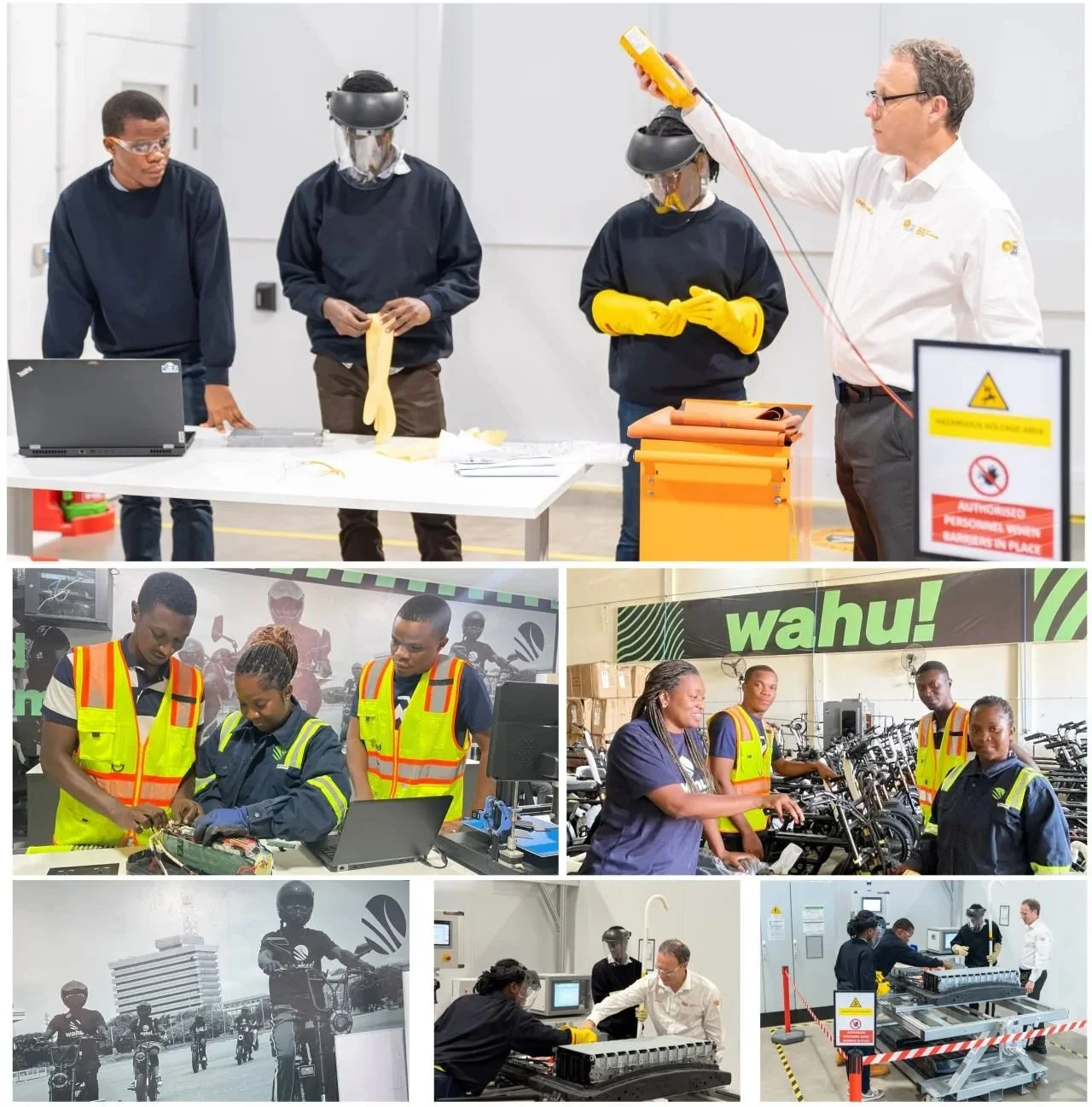
Photo Credit: Ghana JET
Why Wahu, Why Now?
Wahu Mobility is not a speculative start-up. It operates Ghana’s first electric vehicle Completely Knocked Down (CKD) assembly plant in Accra, producing connected electric bikes designed primarily for delivery riders. Unlike simple 'screwdriver' assembly where parts arrive pre-joined, Wahu’s CKD manufacturing involves building every vehicle from thousands of individual components right here in Accra. This deep industrial commitment does more than just create jobs; it transfers critical EV technology to the Ghanaian workforce and allows us to source from local suppliers, transforming Ghana from an importer of vehicles into a hub for African green innovation.
Its business model extends beyond hardware to digital platforms that bundle financing, maintenance and insurance — an ecosystem approach tailored to informal and semi-formal urban transport operators. Co-founded by Ghanaian entrepreneur Valerie Labi, with the support of two well-known German car executives, Toni Heigl, former BMW manager, and Peter Schwarzenbauer, former BMW board member, Wahu Mobility has attracted backing from pan-African venture capital platform Launch Africa Ventures, signalling investor confidence in its vertically integrated e-mobility model.
That capital alignment — pairing mission-driven leadership with institutional risk capital — reinforces Wahu’s positioning not merely as an assembler of bikes, but as a scalable industrial and technology play within Ghana’s clean transport transition. The company’s leadership profile also shows a commitment to advancing green transport, with women at the helm, and reinforces its governance narrative, blending climate ambition, gender inclusion, and venture-backed scale.
They have also had an engagement with the President of Ghana, where discussions centred on advancing sustainable mobility and strengthening support for women-led innovation. This engagement situates Wahu Mobility not only within the private investment ecosystem, but also within high-level policy dialogue around Ghana’s green industrialisation agenda — reinforcing its role as a strategic actor in the country’s low-carbon transport transformation.
JET’s engagement with Wahu did not begin in 2025. In 2024, the programme supported technical assessments of battery chemistries used in two- and three-wheeler platforms, including evaluations of performance, durability and suitability for Ghana’s climatic conditions. Lithium Iron Phosphate (LFP) and Nickel Manganese Cobalt (NMC) chemistries — which together account for over 90 per cent of the global EV battery market — were benchmarked against local use-case realities: heat stress, charging variability and load profiles typical of commercial riders.
The Coventry immersion builds on that foundation. At UKBIC, the engineers were exposed to industrial-scale mixing, coating, calendaring, module assembly and quality assurance systems — precisely the translational steps that often separate promising prototypes from bankable production lines. UKBIC’s mandate is to bridge research and manufacturing, reducing investor risk in new battery technologies. For a Ghanaian firm contemplating localisation, that knowledge transfer is strategic.
Notably, the cohort included a female engineer — a modest but meaningful signal in a sector where technical roles remain male-dominated.
A Broader Energy Diplomacy Architecture
The battery initiative sits within a wider UK-Ghana energy and industrial collaboration framework.
Under the JET programme—backed by more than £124 million—the UK has positioned itself as a partner in Ghana’s industrial transformation, spanning automotive, textiles, pharmaceuticals and advanced manufacturing. In the energy space specifically, UK-linked engagements have extended beyond mobility.
The UK-Ghana Chamber of Commerce (UKGCC), for instance, has played an active role in facilitating investment dialogue around the Petroleum Hub Development Corporation (PHDC). In London, PHDC reaffirmed its strategic alignment with UKGCC, leveraging the platform to engage UK institutional investors and highlight the ESG-aligned dimensions of the Petroleum Hub project. The diplomacy was as much about capital mobilisation as it was about narrative positioning—framing Ghana’s downstream ambitions within a global sustainability context.
This dual-track engagement—supporting both hydrocarbons value addition and clean mobility industrialisation—reflects a pragmatic transition model. Ghana’s pathway to net zero does not bypass hydrocarbons; it seeks to manage them alongside emerging low-carbon sectors.
Within that matrix, battery capability development is neither symbolic nor isolated. It is part of a broader industrial strategy that blends investment promotion, ESG positioning and technical capacity building.
Ghana’s EV Baseline — Momentum with Constraints
Electric mobility in Ghana is advancing, albeit unevenly. Between 2017 and 2021, more than 17,000 plug-in electric vehicles were imported, according to official baseline surveys, with motorised two- and three-wheelers forming a substantial share. Hybrids dominate formal vehicle registrations, while fully electric platforms are gaining traction in commercial micro-mobility segments.
Policy scaffolding has begun to align with this momentum. The National Electric Vehicle Policy complements the Drive Electric Initiative launched by the Energy Commission, and recent fiscal reforms have removed import duties on EVs and their components. Ghana has also commissioned its first solar-powered EV charging station, signalling early infrastructure development.
Yet structural gaps remain. Charging networks are sparse outside major urban corridors. Grid reliability, though improving, remains a consideration for fleet operators. And critically, upstream value capture — particularly in batteries — is negligible.
This is where industrial policy intersects with geology. Ghana has confirmed commercially significant deposits of lithium and graphite, both critical inputs in battery manufacturing.
From Training to Industrial Capability
The immediate deliverable from the Coventry immersion is knowledge diffusion. Wahu’s engineers are expected to cascade technical insights across the company’s engineering team and lay the groundwork for a state-of-the-art EV battery laboratory in Ghana.
The longer-term ambition—local battery assembly and potentially manufacturing—will depend on capital formation, regulatory certainty, supply chain integration and sustained demand growth. Global battery markets remain intensely competitive, dominated by scale players in Asia.
Yet Ghana’s comparative advantage may lie in targeted segments—particularly two- and three-wheelers—where localisation, customised design and proximity to end-users can offset scale disadvantages.
If batteries constitute the majority of EV cost, and if Ghana is serious about electrifying transport within its 2060 net-zero framework, then domestic capability in battery engineering becomes a strategic necessity rather than a discretionary aspiration.
The UK-Ghana battery collaboration, modest in scale but deliberate in design, signals a shift from policy ambition to technical preparation. In an era where industrial sovereignty increasingly hinges on control over energy transition technologies, Ghana’s bet on skills transfer may prove a pivotal first move.
