WAPCo Fortifies Regional Gas Backbone with Strategic Five-Year Integrity Milestone at Lagos Beach Compressor Station
In cross-border gas transmission, credibility is earned in steel and discipline — not speeches. The West African Gas Pipeline Company Limited has reinforced that principle with the successful completion of a five-year statutory inspection at its Lagos Beach Compressor Station, tightening asset integrity at a critical compression hub just as the West African Gas Pipeline posts record availability and throughput. It is a technical milestone with strategic implications for regional energy security.
Takoradi, Ghana | February 23, 2026 - In the unforgiving economics of cross-border gas transmission, reliability is not an aspiration. It is the product.
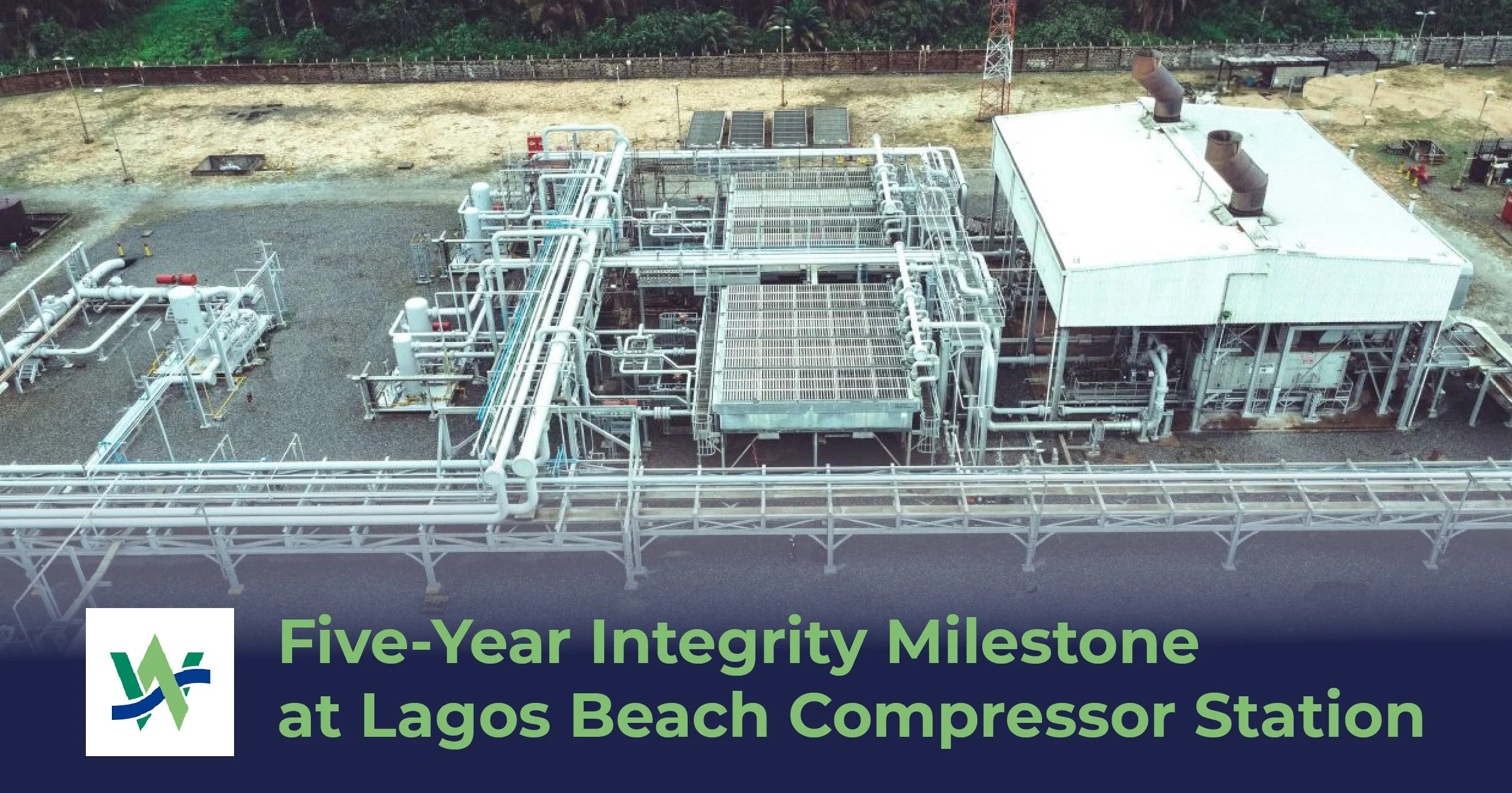
The West African Gas Pipeline Company Limited (WAPCo) quietly reinforced that proposition, announcing the successful completion of a five-year statutory inspection of critical heat exchangers at its Lagos Beach Compressor Station (LBCS). The milestone, delivered safely and on schedule, is less about routine compliance than it is about sustaining the operational discipline underpinning the West African Gas Pipeline (WAGP) system.
The Nerve Centre at Badagry
Located in Badagry, Lagos State, LBCS is one of the strategic compression hubs on the WAGP network, regulating pressure and ensuring efficient gas flow from Nigeria through Benin and Togo to Ghana. It is also the launch point for routine pipeline “pigging” operations — mechanical cleaning and inspection devices sent offshore and received at the Takoradi Regulating and Metering Station in Ghana — a practice that has become central to WAPCo’s evolving asset integrity culture.
The latest inspection programme focused on core thermal management equipment: Air Gas Coolers for Trains 1 and 2, turbine lube oil coolers, gas generator lubricant coolers and associated systems. These heat exchangers are not peripheral components. They stabilise gas temperatures, protect rotating equipment and preserve safe operating envelopes across the compression process. In a high-pressure transmission environment, thermal instability translates quickly into mechanical risk.
The exercise forms part of WAPCo’s long-term Asset Integrity Management framework and is mandated under statutory requirements. But as company officials have previously acknowledged during offshore cleaning campaigns, the technical learning curve has been cumulative. “We improve as we keep going,” Operations and Maintenance Superintendent Benoni Owusu Ayeh remarked in a meeting with journalists in Takoradi — an understated reflection of institutional memory built from operational setbacks and recovery.
From Compliance to Performance Culture
The inspection was executed in collaboration with Ehijesy Technological Services Limited, an indigenous engineering and asset integrity company with experience spanning corrosion control, cathodic protection design, onshore and offshore construction and inspection services. The partnership signals a deliberate blend of regional technical capacity with international standards — a combination increasingly central to West Africa’s upstream and midstream resilience narrative.
Crucially, the project was delivered without incident and within schedule parameters, underscoring an operational tempo that has defined WAPCo’s recent trajectory.
The timing is notable. The company is coming off what it has described as its strongest operational year on record. In 2025, the WAGP system achieved 99% asset availability and delivered peak gas volumes 22% higher year-on-year — performance metrics that Managing Director Abiodun Bodunrin highlighted at the 2026 edition of the Nigeria International Energy Summit as evidence of infrastructure upgrades and strengthened collaboration, including with the Nigerian National Petroleum Company (NNPC).
Such statistics are not mere corporate boast. For Ghanaian thermal power plants reliant on Nigerian gas, and for industrial users across the corridor, system availability directly correlates with grid stability and economic output.
A Proven Cross-Border Model
At regional industry forums, including SAIPEC 2026, WAPCo has positioned the WAGP as a functioning template for cross-border energy collaboration — a case study in how coordinated infrastructure governance and political alignment can underpin economic integration. That framing gains credibility only when supported by granular operational performance.
The five-year statutory inspection at LBCS fits squarely within that narrative. Asset integrity is the invisible architecture beneath regional energy diplomacy. Without disciplined inspection cycles, corrosion monitoring, thermal control and mechanical reliability, the rhetoric of integration collapses under the weight of physics.
In practical terms, proactive inspection reduces unplanned downtime, mitigates environmental and safety risks, and protects long-run capital investment. In strategic terms, it signals to regulators, offtakers and investors that the WAGP corridor is not merely functional but institutionalised.
The Quiet Work That Keeps Gas Flowing
Pipeline systems rarely make headlines when they operate flawlessly. Their importance is often measured only in disruption. By completing its statutory inspection programme at LBCS without incident, WAPCo reinforces a culture where reliability is engineered rather than assumed.
In an energy transition discourse increasingly dominated by renewables and decarbonisation targets, West Africa’s gas backbone remains foundational to grid stability and industrialisation. Sustaining that backbone requires unglamorous, technically rigorous work — inspections, pigging campaigns, corrosion control, equipment upgrades — executed with precision.
If 2025 represented a record year for throughput and availability, milestones like this suggest 2026 will be defined by consolidation: strengthening what already works.
For a region still building confidence in shared infrastructure, that may be the most strategic milestone of all.
