
US Restricts Iranian Port Access As Hormuz Trade Splits; Oil Slips On Diplomatic Signals Despite Strategic Maritime Tightening
A calibrated U.S. maritime blockade on Iranian port traffic has fractured normal trade flows through the Strait of Hormuz without fully closing the chokepoint itself—splitting the world’s most critical energy artery into restricted and open channels. As tanker backlogs swell, crude prices edge lower on renewed diplomatic signals, and major powers scramble to adjust, the Strait has become less a gateway than a controlled pressure valve in a high-stakes negotiation still unfolding behind closed doors.
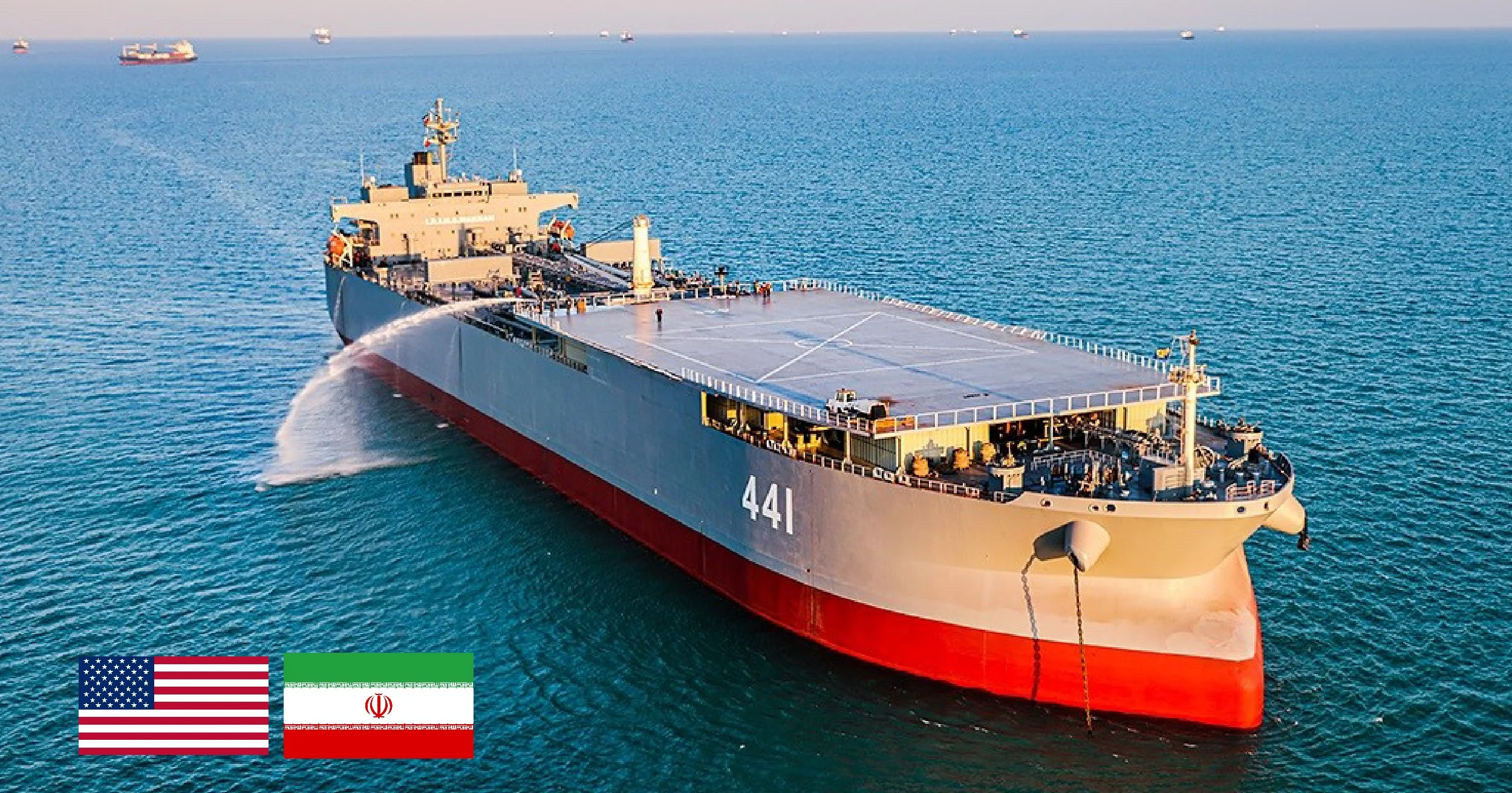
Washington / Strait Of Hormuz | April 14, 2026 — The United States has begun enforcing a targeted maritime restriction on Iranian port traffic while preserving uninterrupted transit through the Strait of Hormuz for non-Iranian-bound vessels—a calibrated move that has reshaped shipping flows in real time, coincided with a sharp collapse in regional throughput, and contributed to a modest decline in crude prices as diplomatic engagement quietly persists behind the scenes.
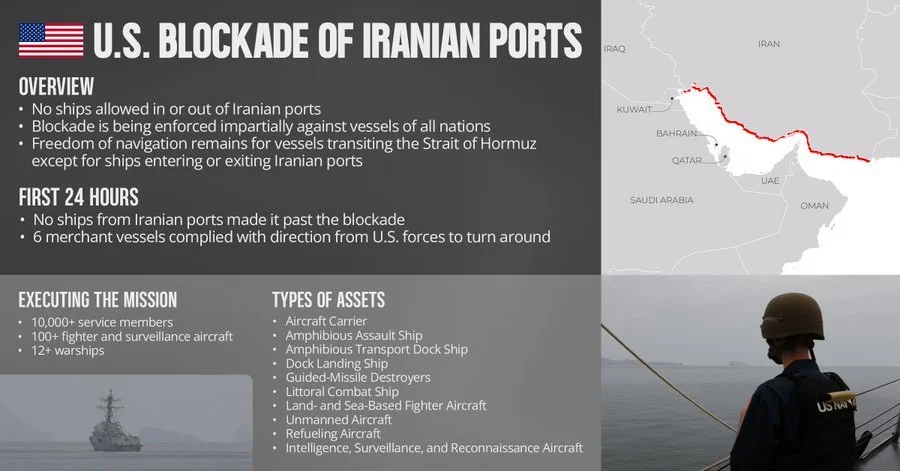
At 10 a.m. ET on April 13, U.S. Central Command (CENTCOM) initiated enforcement of a directive restricting maritime traffic entering or exiting Iranian ports across the Persian Gulf and Gulf of Oman. The operation, involving more than 10,000 U.S. sailors, marines, and airmen alongside over a dozen warships and supporting aircraft, marks a significant escalation in maritime pressure on Iran’s export and import channels.
However, CENTCOM simultaneously clarified that vessels transiting the Strait of Hormuz to and from non-Iranian ports would not be impeded, effectively separating port access enforcement from broader chokepoint navigation. The result is a bifurcated operating environment: constrained at Iranian terminals, but partially open at the Strait itself.
Early enforcement data underscores the immediate effect of the policy. Within the first 24 hours, no vessels are reported to have successfully proceeded into or out of Iranian ports under blockade conditions, while six merchant vessels were directed to turn back toward Iranian harbours after encountering U.S. naval instructions.
Strait Flows Collapse As Backlog Builds Behind A Restricted Gateway
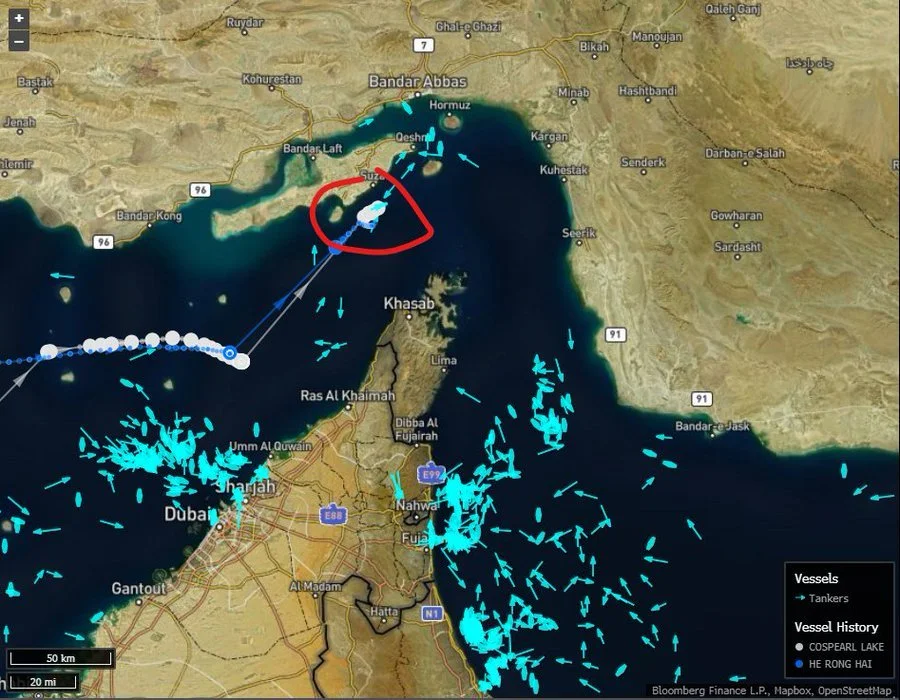
The blockade arrives atop an already strained maritime system in the Strait of Hormuz, where traffic has fallen sharply to roughly 7–18 vessels per day from a pre-crisis baseline near 140.
More than 1,000 vessels are now understood to be queued outside the waterway, including an estimated 187 tankers holding approximately 172 million barrels of crude oil. The backlog reflects not only geopolitical risk, but also operational uncertainty stemming from earlier conflict conditions that disrupted normal routing and risk assessment across commercial fleets.
While some tanker movements have continued—including both Greek-owned and Chinese-linked vessels crossing the Strait under adjusted routing protocols—these flows have not offset the broader contraction in throughput capacity across the system.
Importantly, the continued transit of select non-Iranian cargoes does not represent a breach of the blockade framework. Rather, it reflects the explicit design of the U.S. posture, which distinguishes between Iranian port-linked traffic and general maritime passage through the Strait.
Markets Reprice Risk As Diplomacy Remains Active
Crude oil prices eased in trading, with futures slipping as markets weighed supply disruption against signals that diplomatic channels remain active.
Five sources cited by Reuters indicated that U.S. and Iranian negotiating teams may return to discussions in Islamabad later this week, with regional mediators—including Egypt, Pakistan, and Turkey—working to bridge remaining gaps ahead of a ceasefire timeline expiring on April 21.
The price reaction reflects a familiar pattern in energy markets: initial risk repricing on escalation, followed by partial retracement as the probability of negotiated off-ramps re-enters the calculus.
Negotiations Stalled But Not Closed
Talks held in Islamabad on April 11–12 failed to produce an agreement, with delegations subsequently departing the region. U.S. representatives—including Vice President JD Vance, Special Envoy Steve Witkoff, and Jared Kushner—left following the breakdown, while Iranian counterparts also exited without settlement.
Despite the impasse, intermediary diplomatic engagement has continued. Regional actors are attempting to reconstitute dialogue channels before the ceasefire window closes, keeping a narrow path open for further negotiation even as enforcement pressure intensifies at sea.
Energy Security Responses Begin To Accumulate
The disruption has prompted precautionary responses among major importers. Japan, which relies on the Middle East for more than 90% of its crude imports, has begun releasing additional strategic reserves to cushion potential supply volatility.
At the same time, shipping behaviour across the region has adjusted rapidly, with tanker routing increasingly shaped by enforcement geography rather than traditional commercial optimisation.
U.S. crude flows have also shifted upward, with cargoes increasingly directed toward American ports as global trade patterns reconfigure around uncertainty in the Strait corridor. While not yet representing a structural “record” in export volumes, the direction of movement reflects a clear reorientation of supply chains toward perceived jurisdictional stability.
Mine Warfare Legacy Continues To Shape Operational Reality
Underlying the current maritime posture is a persistent operational constraint: degraded mine countermeasure capacity and incomplete environmental certainty in parts of the Strait.
Earlier conflict conditions saw naval mines deployed in irregular patterns, with some drifting from their original positions and not fully mapped. Western naval forces have acknowledged limits in mine-clearing capability at scale, contributing to sustained caution among commercial operators.
The resulting environment is one in which legal access and physical confidence diverge—traffic remains permissible in principle, but constrained in practice by residual risk.
Outlook: Controlled Pressure, Unresolved Trade-Off
The current U.S. posture does not constitute a full closure of the Strait of Hormuz, but rather a targeted restriction on Iranian port activity layered onto an already disrupted maritime system.
The effect is a segmented flow architecture: restricted at Iranian nodes, partially open at the chokepoint, and highly sensitive to diplomatic signalling.
With negotiations still active but unresolved, and enforcement now operational, the Strait has entered a phase defined less by binary access than by calibrated constraint—where energy flows, military posture, and diplomacy are now co-dependent variables in a single tightening system.
