
Mission 300 Strengthens West Africa’s Grid as WAPP Expands 800MW Regional Transmission Ring
West Africa’s power deficit is no longer just a generation problem—it is a systems problem. With an 800-megawatt, 225 kilovolt transmission ring now linking Guinea, Senegal, The Gambia and Guinea-Bissau under the West African Power Pool, the region is moving from fragmented national grids toward a functioning electricity market. Backed by Mission 300, the new interconnector does more than transmit power; it rewires the economics of trade, resilience and clean hydropower integration across West Africa.
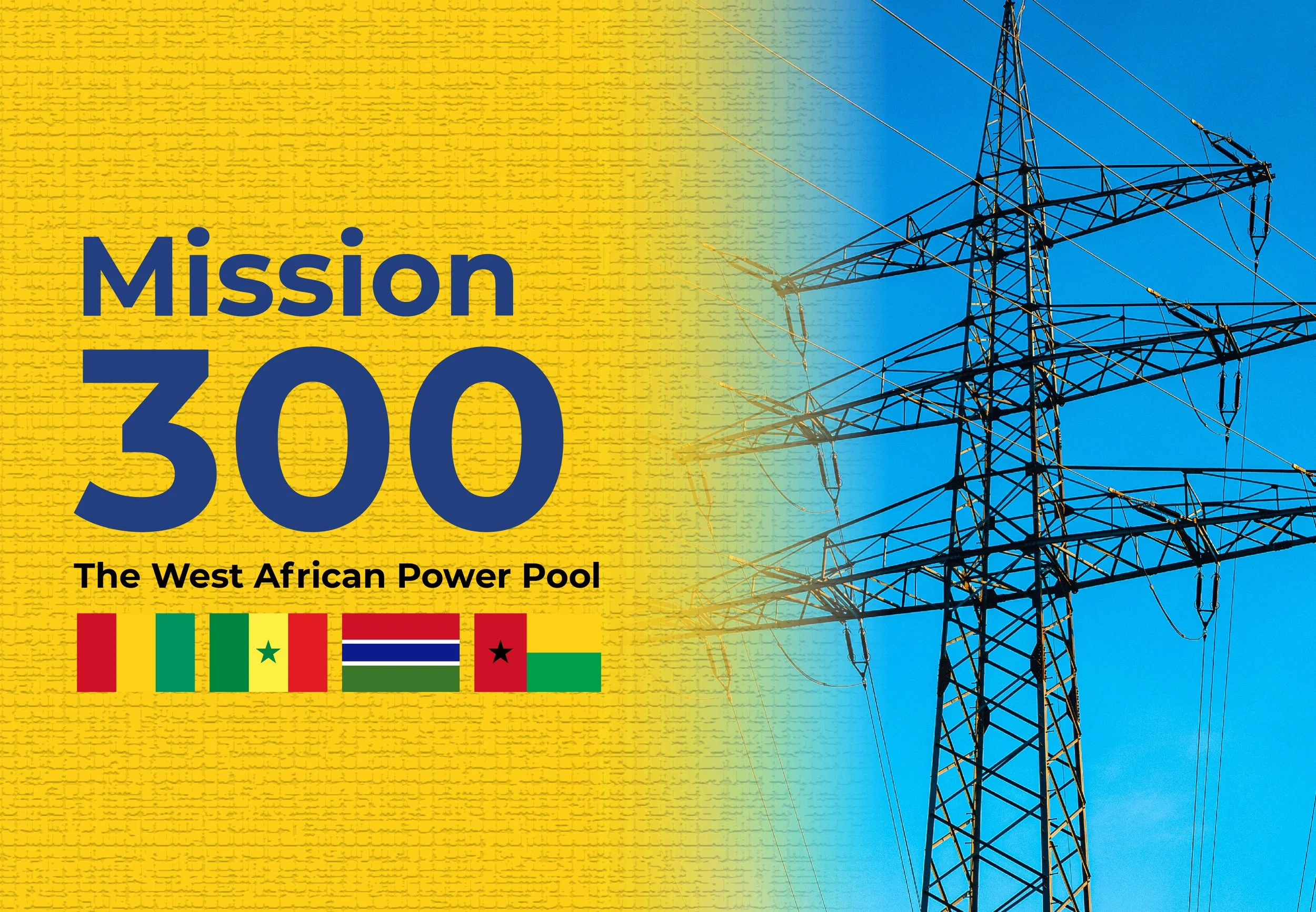
West Africa | February 20, 2026 - For decades, West Africa’s power story has been one of paradox: abundant hydro, gas and solar potential coexisting with chronic shortages, stranded generation and fragile national grids. That contradiction is now being tested in earnest. Under Mission 300, a continent-wide drive to accelerate universal access, the region’s most ambitious transmission architecture is beginning to look less aspirational and more operational.
At the centre of this shift is a 225 kilovolt transmission ring linking West African Power Pool (WAPP) members Guinea, Senegal, The Gambia and Guinea-Bissau. With an installed transfer capacity of roughly 800 megawatts, the ring is not merely a technical milestone. It is a structural intervention in how power is generated, priced and traded across borders.
This is what integration looks like in steel and copper.
From Fragmented Grids to a Regional Market
Established in 1999 under the auspices of the Economic Community of West African States, WAPP was conceived as a mechanism to interconnect 14 national power systems into a single regional electricity market. The logic was straightforward: diversify generation sources, pool reserves, reduce system costs and improve reliability.
Execution, however, has taken years of financing, harmonisation of grid codes, tariff alignment and political negotiation.
The new 225 kV ring marks a decisive step in closing the loop. By connecting Guinea’s hydropower surplus to coastal demand centres in Senegal and beyond, the infrastructure enables clean energy exports while reducing reliance on high-cost thermal back-up generation. For Guinea-Bissau and The Gambia—historically energy-import constrained—the ring enhances both supply security and voltage stability.
In practical terms, this 800 MW corridor allows system operators to optimise dispatch across borders. Excess hydropower in the wet season can now move where it is needed. Thermal plants can ramp down when imports are cheaper. Reserve margins can be shared rather than duplicated.
The result is not just trade, but resilience.
Mission 300: Ambition Meets Architecture
The political framing comes from Mission 300, a continental push to connect 300 million additional Africans to electricity by the end of the decade. Its premise is that access is not only a distribution challenge but a systems one. Transmission and regional integration are prerequisites for scaling generation and crowding in private capital.
In that sense, the Guinea–Senegal–Gambia–Guinea-Bissau ring is a proof point. It demonstrates that cross-border infrastructure—often dismissed as diplomatically complex and financially risky—can be delivered at scale.
Critically, this ring does not operate in isolation. It is embedded within WAPP’s evolving master plan, which envisions a fully synchronised regional grid with harmonised transmission tariffs and a competitive regional electricity market. As additional interconnectors come online, the network effect strengthens. Each new line increases optionality, liquidity and system redundancy.
This is the architecture of a market, not a patchwork of bilateral deals.
Development Finance as System Catalyst
The economics are equally important. Regional interconnections lower the levelised cost of electricity by allowing countries to tap the least-cost generation across borders rather than build duplicative domestic capacity. For capital-constrained economies, that distinction matters.
Multilateral support—particularly from the World Bank Group and other development partners—has underwritten much of this expansion. But the long-term objective is self-sustaining trade, not perpetual subsidy. Once interconnectors are operational and tariff regimes are aligned, private generators gain confidence in off-take beyond their domestic markets.
This is especially relevant as West Africa seeks to integrate more variable renewables. Hydropower exports from Guinea can help balance solar penetration elsewhere. Gas-fired capacity in coastal economies can stabilise systems during dry seasons. Regionalisation turns intermittency into a portfolio management problem rather than a national vulnerability.

Ghana’s Stake in the Grid
For Ghana, a longstanding beneficiary and participant in WAPP, the implications are strategic. Ghana’s grid already exchanges power with neighbouring states and has leveraged regional trade during periods of domestic surplus and deficit. As WAPP’s backbone strengthens further west, the integrity of the entire interconnected system improves.
Simultaneously, Ghana is advancing distributed renewable ambitions at home. The Energy Commission and the Accelerated Partnership for Renewables in Africa (APRA)-linked initiatives to strengthen engineering, procurement and construction capacity for mini-grids underscore a parallel track: decentralised generation anchored in bankable execution. Integration at the regional level and localisation at the distribution edge are not contradictory; they are complementary.
A robust WAPP grid provides the balancing and bulk power framework within which mini-grids and embedded generation can operate more efficiently.
Beyond Infrastructure: Governance and Market Discipline
Yet infrastructure alone does not guarantee market functionality. For WAPP to mature into a fully liquid regional market, member states must sustain regulatory coherence, enforce payment discipline and maintain cost-reflective tariffs. Transmission availability is necessary but not sufficient.
There are also operational challenges. Frequency control across multiple jurisdictions demands sophisticated coordination. Transmission losses must be contained. Political shifts can test contractual stability.
Still, the direction of travel is unmistakable. The 225 kV ring is not an isolated project ribbon-cutting; it is part of a systemic recalibration. As more corridors are energised and cross-border flows become routine rather than exceptional, the region’s energy economics will increasingly be determined at the pool level.
A Structural Bet on Integration
West Africa’s power deficits have long been attributed to insufficient generation. Increasingly, the constraint has been structural fragmentation. Mission 300 recognises that universal access cannot be achieved country by country in isolation.
The WAPP backbone—now reinforced by an 800 MW transmission ring connecting four countries—signals that regional integration is no longer theoretical. It is being wired into existence.
If sustained, this architecture could do more than keep the lights on. It could anchor industrial policy, stabilise macroeconomic planning by reducing fuel import volatility, and underpin the credibility of renewable energy transitions across the sub-region.
The grid, at last, is beginning to behave like a market.
