Calao South Reshapes the Map as Eni Deepens Côte d’Ivoire Gas Play
Italy’s Eni has struck again offshore Côte d’Ivoire, announcing a major gas and condensate discovery at Calao South in Block CI-501. The find, estimated at up to 5.0 Tcf of gas and 450 million barrels of condensate, reinforces the Calao channel complex as a deepwater growth engine and further consolidates Abidjan’s emergence as one of West Africa’s most closely watched offshore plays.
Abidjan | February 16, 2026 - Côte d’Ivoire’s offshore narrative has taken another decisive turn. The Ministry of Mines, Petroleum and Energy announced a significant gas and condensate discovery at Murene South-1X in Block CI-501, confirming what many in the business have long suspected about the Calao channel complex: it is not a one-well wonder, but a hydrocarbon corridor.
The new discovery by Eni, named Calao South, is estimated at up to 5.0 trillion cubic feet of gas and 450 million barrels of condensate, making it the country’s second-largest discovery after Baleine. In volumetric terms, that is roughly 1.4 billion barrels of oil equivalent. The well was drilled in high-quality Cenomanian sands, a reservoir type prized for its porosity and permeability, industry shorthand for rock that can both store hydrocarbons and let them flow.
Murene South-1X was drilled in 2,200 metres of water to a total depth of approximately 5,000 metres by the Saipem Santorini drillship. It encountered around 50 metres of gross hydrocarbon-bearing interval with what the company described as “excellent petrophysical properties.” A full conventional drill stem test will now assess the production capacity of the discovery, a critical step in determining whether the reservoir can sustain commercial flow rates.
For Côte d’Ivoire, the implications extend beyond geology. They point to a maturing deepwater gas strategy, one increasingly anchored by repeatable exploration success.
From Block Acquisition to Basin Architecture
Block CI-501 was not an opportunistic grab. In June 2019, Eni signed contracts for CI-501 and CI-504 as part of a broader offshore licensing round. Located roughly 80 km southwest of Abidjan and spanning water depths between 100 and 2,400 metres, CI-501 sits adjacent to Block CI-205, enabling geological continuity and operational synergies.
From the outset, the strategy was cluster development. By operating contiguous acreage with a 90 percent stake alongside state partner Petroci Holding, Eni positioned itself to leverage shared infrastructure, streamline seismic interpretation and shorten time-to-market in the event of discovery.
That logic intensified in late 2024. During the inaugural SIREXE conference in Abidjan, Eni signed agreements for four additional offshore blocks, expanding its footprint to over 5,700 square kilometres in water depths reaching 3,500 metres. The proximity of these blocks to Calao and Baleine was no coincidence. It was basin architecture in motion, an attempt to build a deepwater hub rather than a patchwork of isolated finds.
The result is a portfolio that now includes ten exploration blocks in Côte d’Ivoire, alongside the flagship Baleine asset.
Baleine as Proof of Concept
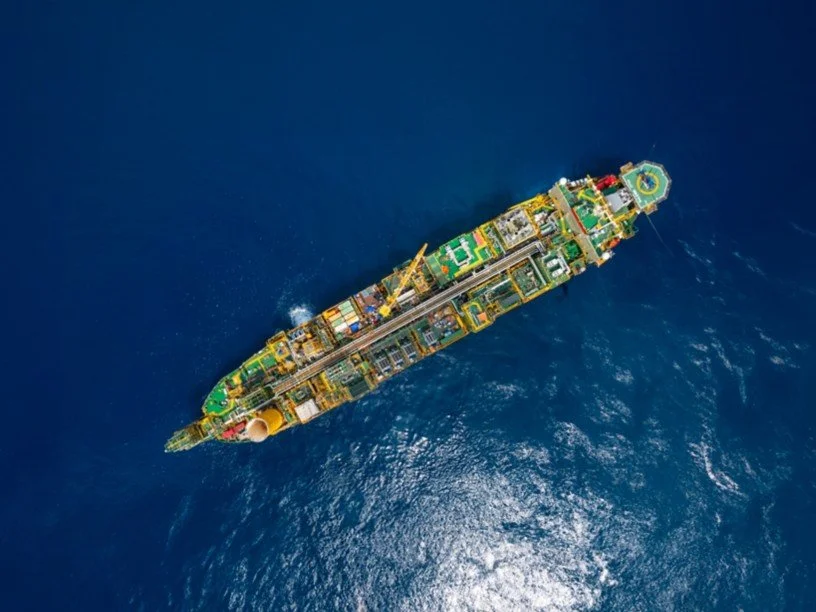
The scale of Calao South cannot be divorced from Baleine’s precedent. Discovered in 2021, the Baleine field is currently producing more than 62,000 barrels of oil per day and over 75 million cubic feet of gas per day from Phases 1 and 2. With Phase 3 under study, output is expected to rise to 150,000 barrels of oil per day and 200 million cubic feet of gas per day.
In practical terms, associated gas from Baleine is already feeding domestic power generation, reducing Côte d’Ivoire’s reliance on imports and underpinning industrial growth. Calao South, if appraised successfully, could reinforce that domestic energy backbone while adding condensate streams valuable for refining and petrochemical use.
For a country balancing export ambition with domestic energy security, that duality matters.
Broader Context: Murphy’s Miss and Basin Resilience
The discovery also lands against a backdrop of mixed exploration fortunes. U.S.-based Murphy Oil Corporation recently encountered a setback in its Ivorian offshore campaign, underscoring the inherent risk of frontier drilling. Exploration is a probability game, not a promise. A dry or sub-commercial well can test investor patience and capital discipline.
Yet Côte d’Ivoire’s basin has shown resilience. While Murphy recalibrates, Eni’s repeat successes in Baleine, Calao and now Calao South suggest that the underlying petroleum system is robust, particularly in deepwater stratigraphic traps within channel complexes.
Strategic Implications
Block CI-501 is operated by Eni (90 percent) in partnership with Petroci Holding (10 percent). Murene South-1X lies approximately 8 km southwest of the Murene-1X discovery in adjacent CI-205, reinforcing the idea of a continuous hydrocarbon fairway.
If the upcoming drill stem test confirms strong flow rates, Calao South could be fast-tracked into a hub development model tied to existing or planned infrastructure. That would compress development timelines and lower unit costs, key metrics in a deepwater environment where capital efficiency determines project viability.
For Côte d’Ivoire, the stakes are larger than one well. The country is gradually repositioning itself as a credible deepwater province in West Africa, at a time when global capital is increasingly selective. Baleine demonstrated execution. Calao South tests scalability.
And in a basin where one company’s miss can rattle sentiment, another’s discovery can restore momentum.
The drill bit has spoken again. Now the flow test must answer.
