Driving Downstream Readiness, Consumer Safety & Regional Leadership

NPA Advances 24-Hour Economy Implementation, Celebrates Institutional Milestones, and Intensifies Public Education
The National Petroleum Authority has taken steps to strengthen enforcement through newly granted prosecutorial powers and is intensifying public education on LPG safety. Marking its 20th anniversary, the Authority is also advancing regional cooperation and preparing for the rollout of Ghana’s 24-hour downstream economy—developments that increasingly reflect the evolving strategic direction being championed by CEO Godwin Kudzo Tameklo (Esq.) for the 2025–2028 period.
I. Enforcement Authority, Sector Vigilance & Coastal Protection
The Authority’s acquisition of prosecutorial powers under Article 88(4) marks not only an operational milestone but a decisive expression of the CEO’s vision for a more assertive and legally empowered regulator. The move strengthens the NPA’s ability to enforce market discipline, eliminate illicit trade, and protect consumers—cornerstones of the leadership’s effort to build a transparent, rules-based downstream environment.
The engagement with the Western Naval Command on September 23 further demonstrates this direction. By reinforcing coastal monitoring and plugging long-standing supply chain vulnerabilities, the NPA is acting on the CEO’s commitment to securing the downstream network through modernized operational standards and stronger institutional authority, ensuring Ghana’s fuel quality and supply integrity are defended end-to-end.
II. Public Education & Consumer Safety: A Unified Commitment
The 2025 Consumer Week Celebrations, and the extensive public education activities leading up to them, align closely with the CEO’s focus on a cleaner energy future and a more empowered consumer base. Through the promotion of safe LPG adoption and the acceleration of the Cylinder Recirculation Model, the NPA is positioning communities at the heart of its transition toward safer and more environmentally responsible fuel usage.
The Authority’s engagements at the Fetu Afahyɛ festival and across tertiary institutions reflect another priority central to the CEO’s vision: strengthening Ghanaian participation through education, responsive service delivery, and improved grievance resolution. The aim is to build a culture where consumers understand their rights, industry players uphold high service standards, and indigenous businesses gain the capacity needed to thrive in an evolving downstream ecosystem.
These efforts reveal a regulator that views public trust and informed participation as indispensable tools for long-term sector stability.


III. Cross-Border Diplomacy & Sub-Regional Energy Integration
The NPA’s engagements with ARDA, SONABHY, and Sierra Leone’s petroleum regulator illustrate how Ghana is steadily emerging as a regional benchmark for downstream governance. This outward-looking posture directly mirrors the CEO’s vision of positioning the NPA as a credible, anti-corruption, high-integrity institution whose practices can stand comparison across the continent.
Plans to enhance supply routes and expand mooring infrastructure correspond to another aspect of this vision: a downstream sector built on resilient infrastructure, shorter turnaround times, and seamless cross-border distribution. The NPA’s growing diplomatic presence is therefore not incidental — it is part of a deliberate effort to elevate Ghana as a dependable, strategically placed petroleum hub for West Africa.
IV. Institutional Legacy, Digital Excellence & Global Representation
The Authority’s 20th anniversary offered a moment to realign institutional identity with the CEO’s emphasis on disciplined management, ethical culture, and strengthened staff professionalism. The celebration highlighted a regulator preparing not just for the next decade of operations, but for a future where staff welfare, inclusive workplaces, and performance-based accountability are central pillars of success.
The NPA’s recognition as the “Most Connected Energy Sector Agency of the Year” further demonstrates the CEO’s technology-forward agenda. By advancing digital integration, enhancing system security, and expanding data-driven oversight, the Authority is pursuing a long-term technological upgrade designed to boost operational efficiency, transparency, and regulatory response speed.
CEO Tameklo’s participation at Africa Oil Week signaled yet another dimension of his vision: ensuring the NPA contributes to continental debates on cleaner fuels, refining efficiency, and energy transition, strengthening Ghana’s place within global policy circles.
V. Infrastructure Assessment & 24-Hour Economy Preparedness
The Authority’s preparations for a national 24-hour economy reflect a central priority within the CEO’s medium-term outlook: ensuring continuous petroleum service delivery supported by strong safety standards, updated infrastructure, and advanced technology. The leadership’s goal is to create an industry capable of operating at world-class levels, with minimal incidents and consistent product quality.
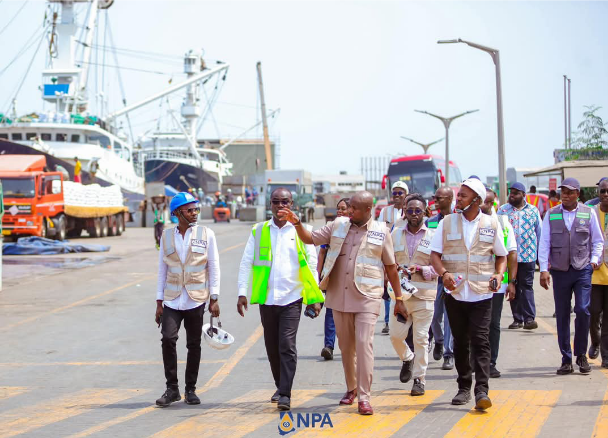
Deputy CEO Dr. Dramani Bukari’s infrastructure assessment underscores this direction. By identifying gaps across terminals and advancing readiness for round-the-clock operations, the NPA is acting on the CEO’s commitment to closing infrastructure deficits, aligning facilities with international standards, and supporting research-driven operational improvements.
These efforts also align with the leadership’s focus on human capital — developing a workforce equipped with the skills, discipline, and inclusivity required to sustain a more complex, high-intensity downstream environment.
Positioning for the Future
Across enforcement, consumer engagement, regional diplomacy, institutional modernization, and infrastructure readiness, the National Petroleum Authority is steadily giving form to the CEO’s vision for a secure, efficient, environmentally responsible, technologically advanced, and people-centered downstream sector.
Rather than presenting this vision separately, the Authority is embedding it in its daily actions — shaping a regulatory future defined by credibility, operational excellence, sustainability, and long-term national impact.
