
Ministry Of Energy &Green Transition: Strategic Momentum, Policy Signals & A Year Of Defining Movements
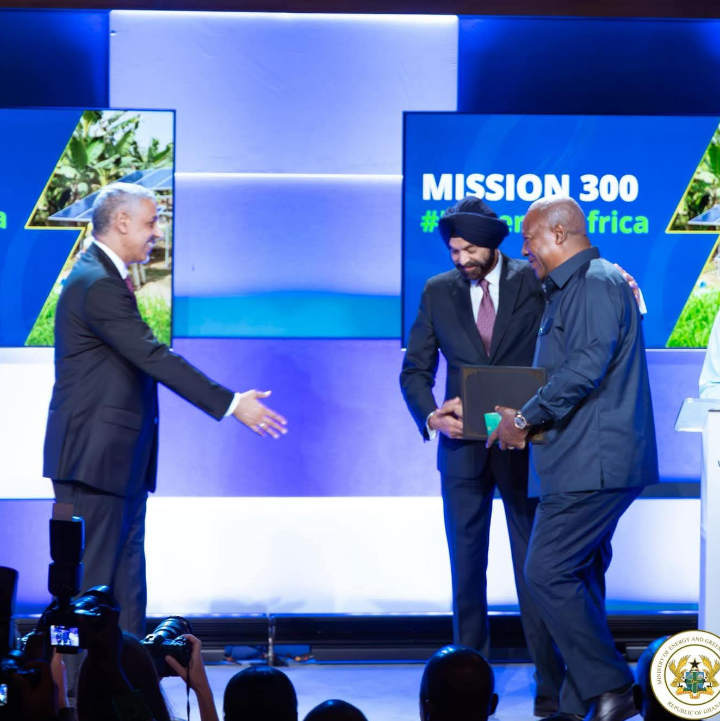
Ghana’s Ministry of Energy and Green Transition (MoEGT) has spent 2025 recalibrating sector confidence, sharpening transition governance and projecting coordinated national readiness across the upstream, gas and power value chains - crucial moves to address Ghana’s systemic energy issues accumulated over the past five years. Across global investment platforms, policy reviews at home, and public-facing engagements in Ghana’s communities, the Ministry’s leadership delivered a finely sequenced message: Ghana’s transition will be inclusive, data-driven and competitively aligned — and the upstream’s recalibration will be anchored in transparency, fiscal clarity and partnership.
I. A Year of Delivery - Recognized
At the helm of Ghana’s bold 2025 energy overhaul, John Abdulai Jinapor was honoured as Energy Sector Reformer of the Year — a recognition that speaks to the sweeping reforms and policy interventions his Ministry has delivered across the power, gas, and upstream petroleum value chains. The award marks not simply symbolic recognition, but affirmation that the Ministry’s push for regulatory clarity, institutional discipline, and sector-wide stability has begun to yield results. Under his stewardship, government-led initiatives have re-anchored sector governance, restored investor confidence, and recalibrated Ghana’s energy identity for the green transition era: transparent in regulation, inclusive in access, competitive in global markets, and strategic in long-term planning.
Hon. Dr. John Abdulai Jinapor’s recognition as Energy Sector Reformer of the Year is rooted in clear, measurable outcomes: under his first year of leadership, Ghana exited the worst phase of its recurring power crisis through aggressive debt restructuring, disciplined load-supply management, and the restoration of operational coordination across GRIDCo, ECG and VRA. The Ministry led targeted emergency procurement to stabilise thermal generation, accelerated gas supply consistency from Atuabo and WAPCo, and enforced accountability measures that curtailed the systemic planning failures that had fuelled instability for years.
Beyond the power sector, he pushed long-delayed upstream decisions toward evidence-based resolution, restored open communication with investors, initiated fiscal clarity reviews, and reinforced local-content compliance where lapses had been tolerated. The award reflects not symbolism, but a year in which the Ministry directly confronted the sector’s accumulated failures — fixing what could be fixed immediately, sequencing what required technical diligence, and signalling plainly where the government would no longer tolerate inefficiency or opacity.
II. Re-Anchoring Ghana’s Transition Pathway: The REMP Review as Institutional Reset
The September multi-stakeholder workshop on updating the Renewable Energy Masterplan (REMP) served as a structural reset of Ghana’s transition architecture. Convened by the Ministry with UNDP support and led technically by the Energy Commission, the taskforce included policymakers, gender specialists, private investors, financiers, regulators, and civil society actors — signalling a deliberate shift toward a whole-of-system approach.
Ing. Seth Mahu, Director for Renewable Energy and Green Transition, opened by framing the review as an essential governance exercise: “Everything around the plan is dynamic; nothing is static. This update provides an opportunity to take stock of where we are and where adjustments are needed.” Participants interrogated the progress gaps of the initial REMP cycle — from rooftop solar adoption to off-grid market failures, licensing bottlenecks, weak domestic manufacturing links, and persistent financing barriers.
Discussions also revisited gender integration frameworks, the future of mini-grid expansion, the viability of feed-in tariff rationalisation, the need for improved data architecture, and the placing of the REMP within Ghana’s Long-Term Low-Emission Development Strategy. By the close of deliberations, the Ministry had secured a renewed policy consensus: the next REMP iteration must be measurable, investment-aligned, and integrated into broader national planning, including green jobs, industrialisation and community livelihoods.
II. AOW:Energy 2025 — Ghana’s Confident, Investor-Ready Posture
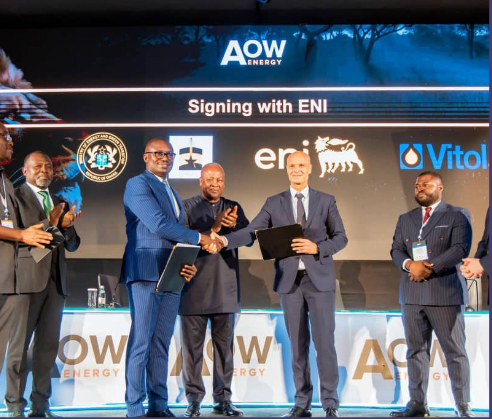
At the AOW:Energy conference in September, Ghana delivered one of its most composed investment diplomacy performances in years. Representing the Ministry, Hon. John Jinapor used his keynote to reinforce Ghana’s dual positioning as a stable upstream environment and an emerging green-transition actor. His remarks were precise and confidence-building: “This event is here to stay. AOW:Energy is not just a conference—it is a platform where deals are done, where the region can converge, and where Africa celebrates its industry with pride.”
The Ghana pavilion drew consistent traffic as GNPC marked its 40th anniversary, reflecting four decades of state-led capacity-building and partnership cultivation. The Ministry’s technical officers used bilateral meetings to provide updates on ongoing development plans, opportunities in appraisal drilling, Ghana’s maturing basin strategy, and the renewed national push for gas commercialisation.
International delegations queried fiscal clarity, licensing timelines, seismic data accessibility, and the status of stalled work programmes. The Ministry delivered consistent responses: regulatory continuity is assured; fiscal frameworks are being refined to enhance competitiveness; and the Commission continues to streamline permitting and digitalise upstream portfolio management. Ghana’s presence at AOW thus became a live demonstration of policy stability in a period of global volatility.
III. Electrification as Social Equity: Transforming 13 Communities in Central Gonja
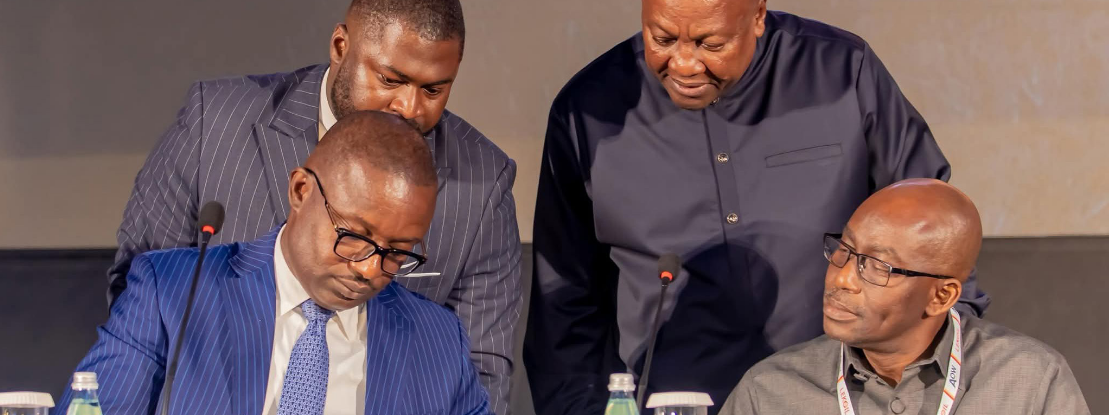
Upon returning from global platforms, the Ministry pivoted to grassroots delivery with the commissioning of new electrification projects across thirteen rural communities in the Central Gonja District. The event reaffirmed the National Electrification Scheme’s commitment to closing the last-mile access gap — a major transition justice concern.
Addressing residents, Minister Jinapor articulated the Ministry’s philosophy with notable clarity:
“Electricity is not just about lighting homes; it is about powering opportunity, driving enterprise, and transforming lives.”
Local chiefs highlighted the economic drag created by decades of energy exclusion: limited night-time commerce, unsafe childbirth conditions, weak school performance, and constrained agricultural processing. Engineers from the Ministry walked residents through the new distribution infrastructure, explaining service expectations, safety protocols, and planned extensions.
The Minister further underscored that Ghana’s energy transition would fail if rural communities are left behind. Electrification, he stressed, is the baseline upon which digital access, refrigeration, irrigation, and modern livelihoods depend. The commissioning thus stood as both an infrastructure milestone and a public declaration that energy equity is a non-negotiable pillar of the transition agenda.
IV. Upstream Renewal Through Clarity, Reform & Evidence: Local Content Conference to Springfield/WCTP2
November provided the most consequential policy signals for the upstream. At the Local Content Conference, Minister Jinapor addressed industry concerns head-on: falling production, delayed work programmes, and the need to restore exploration appetite. His message was measured but firm:
“Through regulatory reforms, fiscal incentives, gas development initiatives and renewed focus on local content, we are charting a new course for growth.”
He highlighted the Commission’s tightening of procurement compliance, efforts to boost indigenous participation in specialised services, and the ongoing review of fiscal and regulatory frameworks to make Ghana’s basin once again competitive with global peers.
The month’s narrative climaxed with the government’s handling of the Springfield/WCTP2 issue — a longstanding sector point of tension. On 19 November, the Ministry disclosed that GNPC and GNPC Explorco, in partnership with the Petroleum Commission, had engaged independent technical and transactional advisors to conduct a full commercial and subsurface evaluation of the asset. The communication emphasised that decisions would be guided by evidence, not speculation.
In his November 21 media engagement, Minister Jinapor provided the clearest articulation yet of the government’s guiding test:
• Support will be given only if the independent assessment recommends it.
• The evaluation must satisfy objective technical and commercial criteria.
• The government will withdraw interest if the findings do not meet national-interest thresholds.
This transparent sequencing — advisor engagement, evidence generation, conditional government posture — marked a deliberate departure from the opacity that has historically affected such negotiations. The Ministry’s approach effectively reset investor expectations: policy support is available, but only where data and commercial sense align.
Conclusion: A Policy Year Defined by Coherence, Competence & Measured Ambition
Across a busy quarter, the Ministry advanced a consistent principle: Ghana’s energy future will be steered through realism, partnership and institutional discipline. The REMP review restored analytical depth to the transition framework; the AOW:Energy engagements repositioned Ghana as both a stable upstream player and a continental convener; the Central Gonja electrification reaffirmed the Ministry’s social focus; and the carefully sequenced Springfield/WCTP2 process demonstrated a renewed commitment to evidence-based governance.
In all, the Ministry’s movements reveal a leadership intent on synchronising global diplomacy, domestic delivery and regulatory credibility. With production challenges and transition pressures converging, this coherence may well be the cornerstone of Ghana’s energy trajectory into 2026 and beyond.
